Buying guide
Battery vs Gas Snow Blowers in 2026: The Honest State of the Switch
The battery snow blower conversation has two dishonest versions: the marketing one, where a spec-sheet runtime clears an '18-car driveway' of laboratory snow, and the reflexive one, where no battery machine could ever survive a real winter. Both are out of date. In 2026, battery machines have genuinely won the single-stage category, are credibly attacking the two-stage one, and still lose the long-rural-driveway war on runtime and refueling. Here's where the lines actually sit.
What battery has genuinely won
For the paved one-to-two-car driveway — single-stage duty — battery machines from EGO, Toro (the 60V Power Clear e21, around $799-$899 in kit form), Greenworks, and Ryobi are no longer the compromise option; they're arguably the default. The workload suits the technology: 20-40 minutes of clearing, done, back on the charger. And the quality-of-life wins are total. Push a button and it runs, at 10°F, every time — no choke ritual, no pull cord, no prayer. No carburetor to gum up over the summer, no stale fuel, no oil changes, no gas can in the garage, no exhaust in your face. They're quiet enough to clear at 5 a.m. without becoming the neighborhood villain.
The starting story deserves emphasis because it inverts the old hierarchy. The number-one failure mode of gas snow blowers isn't power — it's the machine that sat all summer with ethanol fuel in the carb and won't start in the season's first storm (a genre that fills owner forums every November). Battery machines simply do not have this failure mode. For a homeowner who doesn't want a small-engine hobby, that alone justifies the category.
The runtime truth: marketing minutes vs wet-snow minutes
Every battery snow blower is marketed in car-driveways of ideal snow: Toro claims the e21 clears up to a 12-car driveway on its 7.5Ah pack, EGO claims its two-stage clears 8 inches from an 18-car driveway on two 7.5Ah batteries. Treat these like EPA fuel economy — a controlled-conditions ceiling, not a promise. Motor load scales brutally with snow density: the same pack that breezes through 6 inches of powder can dump half its charge into a few passes of 8-inch wet slush, and owners consistently report roughly half the marketed coverage when the snow is heavy. Little things drain too — running the auger at full speed when you only need 15 feet of throw is paying for 40 feet of throw in amps.
Cold is the second tax. Lithium cells sag below freezing — less usable capacity, weaker peak output — which is why every manufacturer tells you to store the packs indoors and bring them out when it's time to clear. In practice that's the routine: batteries live on a shelf in the house, machine lives in the garage, and you carry the packs out like they're the keys. It works fine, but it's a real behavioral requirement, and the person who leaves packs in an unheated detached garage at -10°F will get a machine that performs like it's insulted.
The honest sizing rule: buy runtime for your worst realistic storm, not your average one, and assume the wet-snow discount. For most single-stage duty that means owning at least two packs (kits usually include them). If your math says you'd need to stop mid-storm and wait 40-60 minutes for a recharge, you've found the boundary of the technology for your driveway — gas doesn't have that boundary, because a second gallon of fuel takes thirty seconds to install.
The money math nobody puts on the box
| Setup (example) | Upfront | 5-year running costs | 5-year total |
|---|---|---|---|
| Corded electric (Snow Joe SJ627E) | ~$250 | Electricity: a few dollars | ~$255 |
| Battery single-stage (Toro e21 kit) | ~$800-$900 | Charging pennies; packs typically outlast 5 yrs | ~$825-$925 |
| Gas single-stage (Toro Power Clear 721 E) | ~$650-$750 | Fuel, oil, stabilizer, the odd carb clean: ~$40-$60/yr | ~$900-$1,050 |
| Battery two-stage (EGO SNT2405, 2×7.5Ah) | ~$1,650 | Charging pennies; pack replacement risk in yrs 5-8 | ~$1,700 |
| Gas two-stage (Ariens Deluxe 24) | ~$1,500 | Fuel, oil, shear pins, belts: ~$50-$80/yr | ~$1,750-$1,900 |
Over five years the categories roughly converge, which surprises people on both sides of the argument. The battery machines' hidden liability arrives later: replacement packs are the whole economic story, at roughly $300-$600 per OEM battery — EGO's 10Ah retails at $549, and a two-stage machine wants two. Quality packs are commonly lasting 7-10 years in seasonal snow duty (a snow blower cycles its batteries maybe 20 times a winter, which is gentle by battery standards), but when replacement day comes it can approach half the price of the original machine. Gas amortizes differently: no cliff, just a steady drip of fuel, oil, stabilizer, shear pins, belts, and — if you skip the fall ritual — a $100+ carb job at the worst possible time. Neither is free; they're differently shaped.
Two-stage battery: real, expensive, and bounded
The frontier in 2026 is the battery two-stage, and EGO's SNT2405 is the machine that made the category credible: a genuine 24-inch, 20-inch-intake two-stage that runs both packs at once ('Peak Power'), throws up to a claimed 50 feet, self-propels in forward and reverse, and — per both reviewers and owner threads — actually handles deep snow and the plow berm rather than gesturing at them. It is not a toy. It is also $1,649 with two 7.5Ah packs at Lowe's, which is Ariens Deluxe money plus a premium, and its runtime obeys the same physics as every battery machine: a big two-stage motor pulling through 10 inches of wet snow drains two packs fast, and a spare pair costs four figures.
That makes the honest verdict about driveway length more than capability. On a two-to-four-car suburban driveway, a battery two-stage does the whole job on one charge with the quality-of-life wins intact, and owners love them. On a 150-foot rural driveway in a snowbelt, you're either buying a second set of batteries or standing in the garage at 6 a.m. watching a charger — while the gas machine next door runs for as long as someone keeps pouring fuel into it. The category will keep improving; the refueling asymmetry won't.
Who should still buy gas, without apology
Gas remains the right answer for long driveways, lake-effect and mountain-snow country, and anyone whose winter includes multiple 12-inch-plus storms with heavy plow berms. The reasons are boring and decisive: unlimited runtime by refuel, full power at any temperature, no dependence on pack pricing a decade from now, and — in the 250cc-and-up two-stage class — a torque reserve for compacted wet snow that battery machines still can't match at comparable money. A $1,499 Ariens Deluxe 24 or a $1,549 Toro Power Max 826 OHAE will still be the machines the owner-forum old guard recommends for real snow, and they'll be right.
Gas also wins some quiet edge cases: the machine stored at an off-grid cabin or unheated outbuilding (no packs to shuttle indoors), the household that already maintains other small engines and has the fuel routine down, and the buyer who wants a 15-20 year machine and doesn't want its economics tied to a proprietary battery ecosystem. The cost of admission is the maintenance religion — ethanol-free or stabilized fuel, the fall ritual, the shear-pin spares. Skip that and gas's reliability advantage inverts.
The clean decision tree: paved driveway up to two cars → battery single-stage, and don't overthink it. Suburban two-stage duty with normal storms → either a battery two-stage (pay the premium, lose the maintenance) or a quality gas machine (pay in upkeep, gain unlimited runtime) — both are defensible in 2026, which is itself the news. Long, rural, or lake-effect → gas, still, and probably for years yet.
Units mentioned in this guide
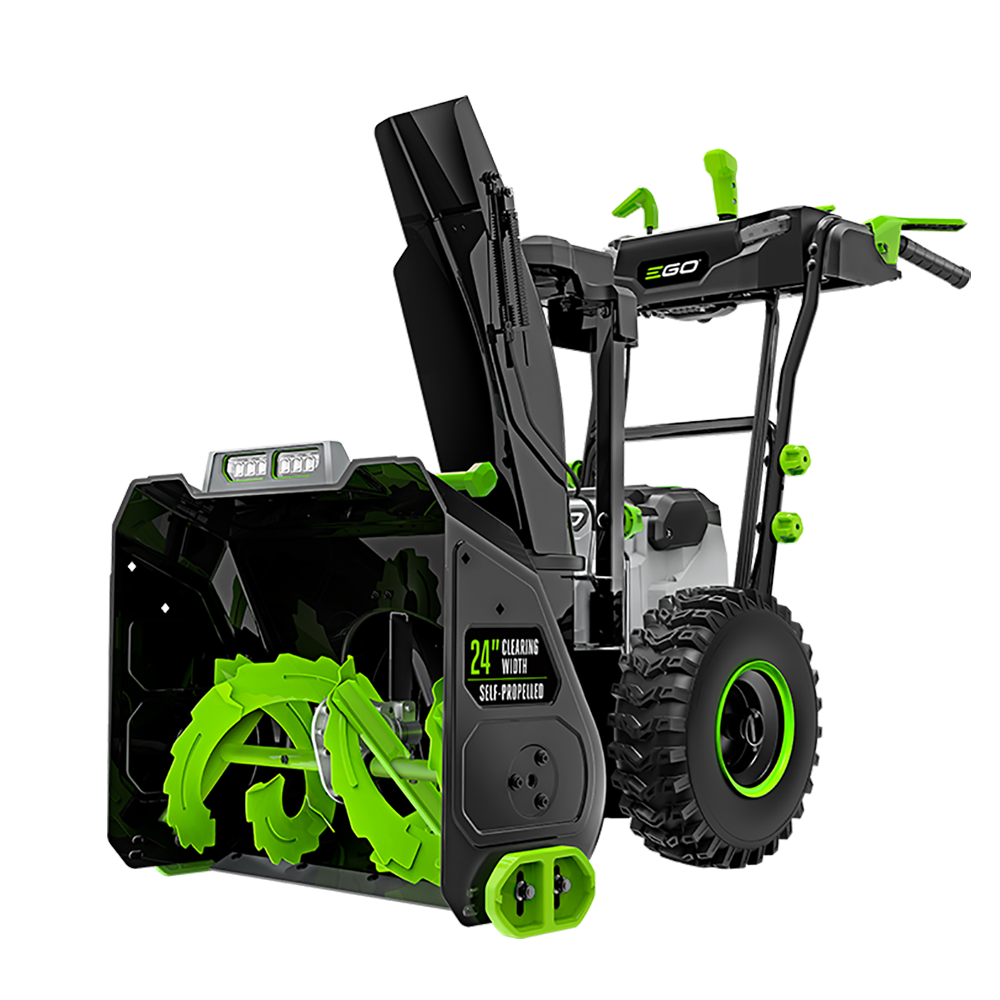
24" wide · 56V 7.5Ah × 2 (Peak Power) · 143 lb
The SNT2405 was the first battery two-stage that felt like a real gas replacement, and with 4.5 stars across nearly 6,000 Ace reviews it has aged well. Independent motors run the drive and steel auger, reverse is genuinely useful on a 143-lb machine, and the 50-foot throw claim is only mildly optimistic in dry snow. The blunt part from owners: the 18-car-driveway runtime claim is powder math. In heavy wet snow one reviewer barely finished a one-car, 50-foot driveway before both 7.5Ah packs quit — figure 30-45 minutes of real work, and budget a second battery set (about $430 each) for long driveways. Packs stored warm indoors shrug off cold mornings; frozen ones sag until they warm. Notably missing at $1,649: heated grips, which Ryobi's Whisper 24 includes for similar money. Versus Toro's 60V Power Max e24 it's the more proven machine with a deeper battery ecosystem; versus an Ariens Compact 24 gas unit you pay roughly $500 extra for push-button silence and zero engine upkeep. For 8-12 inch storms on a 2-3 car driveway, it's the sweet spot of EGO's line.
Best for Suburban homeowners with 2-3 car driveways and 8-12 inch storms who want gas-class two-stage power without the engine upkeep.

21" wide · 35 ft throw · 84 lb
The 721 E has quietly become the default 'just buy the Toro' answer for paved driveways - 1,800+ reviews averaging 4.5 stars and a decade of the 212cc four-stroke proving itself. It throws snow up to 35 feet, starts with a push-button (via 120V cord) or first pull, and the Power Propel paddle drive pulls itself forward hard enough that you're steering more than pushing. The Quick Chute lever spins the 210-degree chute without stopping, and unlike the two-strokes of old there's no gas-oil mixing. Owners' complaints are specific: the chute lever is short and awkward for some hands, single-stage paddles ride up on hardpack and can't touch gravel, and a foot-deep wet storm means slow, half-width bites. Early units had scattered reports of the exhaust cooking a control cable, largely sorted in later production. Honda's exit from US snow blowers removed its only real single-stage rival, so at $799 the 721 E mostly competes with its big brother 821 QZE - buy the 721 if your snow is usually under 9 inches and your driveway holds four cars or fewer.
Best for The suburban homeowner with a 2-4 car paved driveway who wants the proven, no-drama gas single-stage everyone recommends.
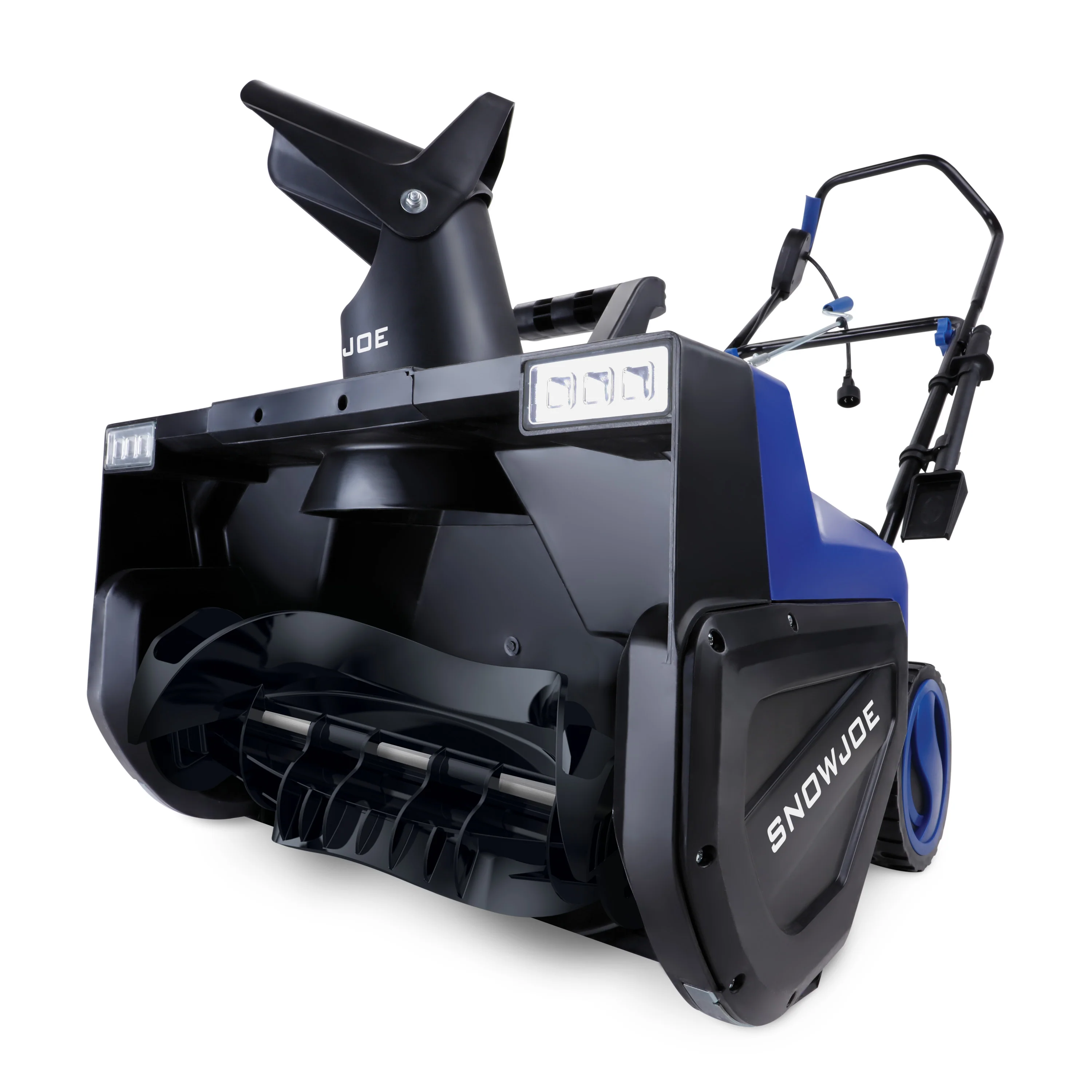
22" wide · 25 ft throw · 35 lb
The SJ627E is the muscle car of corded snow blowers — a 15-amp motor, a 22-inch steel auger, and a 13-inch intake that out-specs every other plug-in on the market, moving a claimed 840 lbs of snow per minute with zero runtime anxiety because the 'battery' is your house. In 6-10 inches of reasonably dry snow it genuinely embarrasses cordless units costing more, and the dual LEDs plus 180° crank chute round out a spec sheet nothing else corded matches. The honest knocks, per its middling 3.9-star Home Depot average: you're tethered to a 12-gauge extension cord you must choreograph around every pass, wet slush overwhelms the chute and drops the 25-foot throw to a sad arc, and some owners report auger belts and plastic chute parts wearing out after a couple of seasons. Against the cheaper WEN 5670 you're paying roughly $80 more for 2 extra inches of width and a deeper intake. For a 50-foot city driveway near an outlet, it's the most power per dollar in snow removal.
Best for Owners of short urban driveways and long sidewalks within cord range who want maximum snow-moving power for around $200.