Buying guide
Clogs, Shear Pins, and Hands: The Safety Chapter Every Owner Skips
Every winter, American ERs treat thousands of snow blower hand injuries, and the overwhelming majority share one story: the machine clogged, the owner reached in, and the auger — engine OFF — snapped forward and took fingers. This is the chapter that keeps you out of that statistic, plus the technique that prevents most clogs in the first place and the small parts (shear pins) whose whole job is breaking so your gearbox doesn't.
Why the auger strikes with the engine off
The mechanism that maims people is stored energy: when wet snow stalls the impeller, the drive belt and springs wind up like a mousetrap, and the packed snow is the only thing holding that tension. Pull the clog free — by hand — and the impeller snaps through a quarter-turn with hundreds of pounds of force, engine running or not, key in your pocket or not. This is why 'I turned it off first' appears in the injury reports right before the injury. The rule has no exceptions and no experienced-owner exemption; ER studies find most victims are men in their 40s and 50s who'd cleared chutes for years: nothing that isn't a tool goes into the chute or auger housing, ever.
The procedure that keeps fingers costs thirty seconds: engine off, wait for all motion to stop, then break up the clog with the clearing tool clipped to every modern machine's handlebar (or any stick, broom handle, or the classic '$5 wooden spoon from the dollar store' the forums swear by), pushing from the chute top down. If the tool meets spring tension, let the tool take the snap — that's its job. Battery machines change the energy math (no idling engine) but not the stored-tension math: pull the battery, then use the tool anyway. The chute clears in under a minute either way; hands don't grow back on any schedule.
Wet heavy snow: the technique that prevents the clog
Clogs happen when snow moves through the machine slower than it arrives — and the counterintuitive fix is full throttle, slow ground speed. Owners instinctively do the opposite in heavy snow (throttle back the roaring engine, hurry the pass), which starves the impeller of the RPM that flings snow clear while feeding it more than it can move. The technique that gets Great Lakes drivews cleared: throttle wide open always (small engines are designed to run there), ground speed one gear slower than feels productive, and take half-width bites in the wet stuff so the machine processes less per foot. Add the free tricks — start while it's still snowing rather than attacking six wet inches at once, and coat the chute and impeller with silicone or ski wax spray each season (snow slides instead of packing) — and most owners never meet the clog the previous section prepares them for.
The related throughput mod the forums love: the impeller kit — rubber paddles bolted to the impeller blades that close the gap to the housing. On older or budget two-stages with a visible gap it genuinely works (tighter clearance means less snow recirculating and re-packing, notably better wet-snow throwing and less clogging); on modern tight-clearance machines it's a solution to a solved problem. The honest checklist: if you can slide a finger between impeller blade and housing, the $30 kit and an afternoon will visibly improve wet-snow performance; if the gap is already paper-thin, spend the afternoon on the wax instead.
Shear pins: the part whose job is dying
Shear pins are mechanical fuses: soft bolts connecting the augers to their drive shaft, designed to snap when the auger bites something immovable — the newspaper under the snow, the frozen plow chunk, the garden hose you forgot — so the $15 pin dies instead of the $300 gearbox. A snapped pin announces itself as one auger side spinning free while the other works, or snow suddenly not feeding on one side. Diagnosis and repair is genuinely a five-minute driveway job: line up the shaft holes, tap out the sheared remains, insert the new pin, clip. The rules that matter: keep a handful of THE CORRECT pins for your model zip-tied to the handlebar (mid-blizzard is when they break, and the hardware store is closed), and never, ever substitute a regular grade bolt because 'the pins keep breaking' — a hardened bolt transfers the impact your pin was absorbing straight into the gearbox, converting a $2 part into a $300 repair with one frozen chunk.
If pins break constantly, the machine is telling you something: skid shoes set too low on gravel (feeding stones), a bent auger contacting the housing, or — most common — the EOD ice pile technique of ramming rather than nibbling. Fix the cause; don't upgrade the fuse.
Units mentioned in this guide

Ariens Deluxe 24
~$1,49924" wide · 50 ft throw · 246 lb
The Deluxe 24 is the machine owners tell people to buy when they ask 'what's the safe choice?' — and the current 921069 keeps that formula: 252cc AX engine, a big 14-inch auger AND 14-inch impeller (most 24s run 12-inch impellers), dual-belt drive, and a 21-inch-tall steel bucket that swallows EOD piles. Owners love that it throws heavy snow a real 40-50 feet and that the cast-iron gear case is basically lifetime hardware. The eternal comparison is Toro's Power Max 826 OXE: the Toro is ~50 lb lighter with slicker chute controls and an anti-clog system, while the Ariens counters with a steel chute, sturdier frame, and better distance. Knocks are real but minor — Auto-Turn can wander on rutted gravel until skids are dialed in, heated grips are no longer standard on the Deluxe line, and several Home Depot reviewers report factory bolts backing out early ('torque everything before first use'). It's the default pick for two-car driveways in serious snow country, and resale is the best in the class.
Best for Two-car paved driveways in snow-belt states — the do-everything 24-inch that handles wet Nor'easter loads without drama.

Cub Cadet 2X 24 IntelliPOWER
~$1,19924" wide · 40 ft throw · 250 lb
The 2X 24 is Cub Cadet's entry two-stage and the one owners usually point at when someone's budget won't stretch to an Ariens Compact 24. The IntelliPOWER 243cc engine is the real story — an electronically governed carb that Cub claims holds up to 18% more usable power, and owners do report less bogging in wet snow than the old HP version. You get trigger power steering and a tall 21-inch intake at a price where Ariens gives you neither. Owner sentiment runs genuinely positive (4.1 across 381 Home Depot reviews) on power, throwing distance, and maneuverability, but the honest knocks are real: it's MTD-built, so the forum crowd questions long-term durability versus an Ariens gearbox, several long-term owners report carburetor gumming that demands religious fuel stabilizer or end-of-season draining, and the plastic chute parts feel cheap next to the steel elsewhere. Buy it for a 2-3 car paved driveway in 12-inch snow country; skip it if you regularly face wet coastal cement — that's where the 26 or 28-inch bigger engines earn their keep.
Best for First-time two-stage buyers with a mid-size paved driveway who want power steering without paying Ariens money.
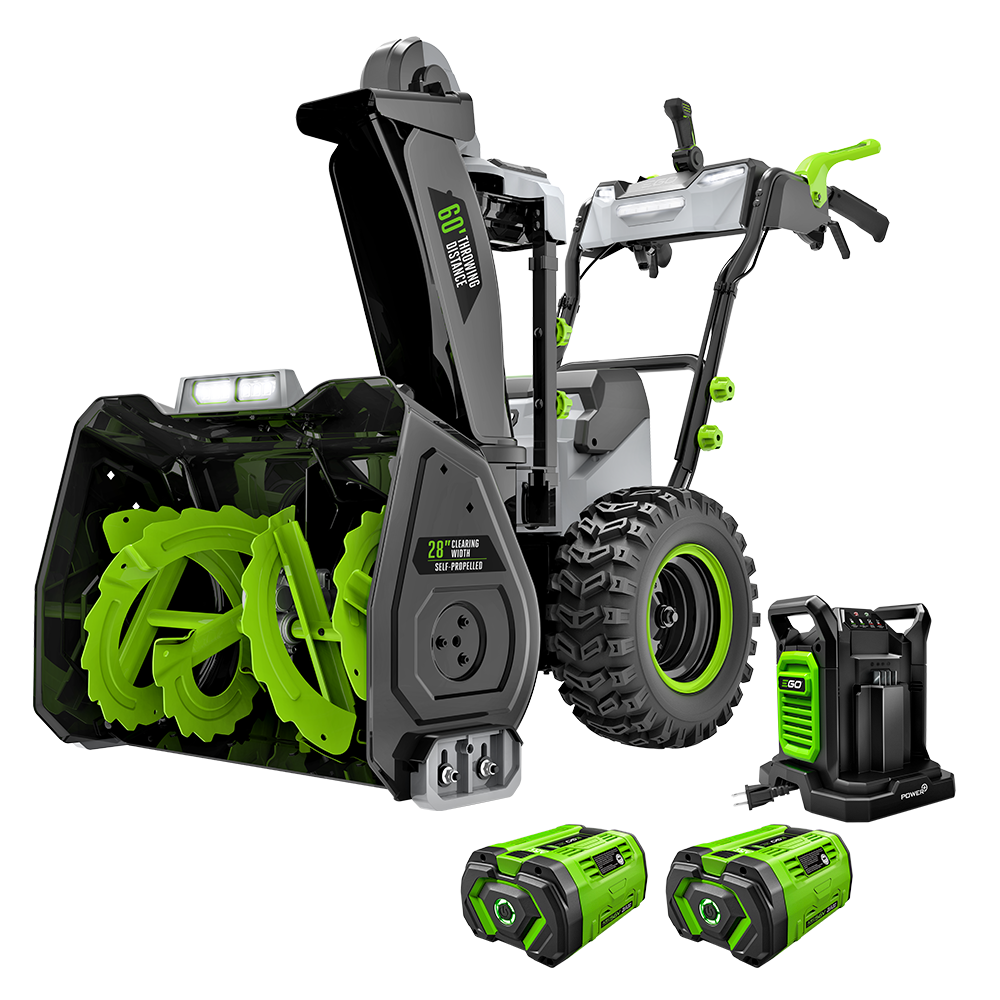
28" wide · 56V 12.0Ah × 2 (Peak Power) · 182 lb · heated grips
The SNT2807 is EGO's flagship, and it's the rare battery two-stage that owners on Snowblower Forum discuss like a gas machine — 28 inches wide, 21-inch intake, trigger steering, heated grips, and a 60-foot throw claim that lands closer to 35-45 feet in real snow. The two included 12Ah packs are the biggest EGO makes, and that's the point: smaller packs technically run it but sag on end-of-driveway piles, so the 32-car-driveway claim only holds in light snow with these monsters aboard. Expect roughly 45-60 minutes of honest work in a heavy storm. Battery math is the knock — a replacement BA6720T runs about $659, $1,099 a pair — so store them indoors; cold-soaked packs lose 10-20% until they warm up. At $2,419 you're paying roughly $1,000 over an Ariens Deluxe 28 gas machine for silence, push-button starts, and zero carburetor drama. Against Toro's 60V Power Max e26, the EGO throws farther and its 2-in-1 electronic chute is slicker to live with. If your area gets repeated foot-plus dumps and you want battery power, this is the only EGO that truly belongs there.
Best for Deep-snow households with long or multi-car driveways who want the most capable battery snow blower money can buy.