Buying guide
Snow Blower Maintenance: The 30 Minutes a Year That Decides Whether It Starts
Snow blowers don't wear out; they rot. The machine works fifteen days a year and sits for 350, and nearly everything that goes wrong — the November no-start, the gummed carburetor, the seized auger — happens during the sitting, not the running. The fix is a fall ritual that takes about 30 minutes and costs maybe $40, and the difference between people who do it and people who don't is the difference between the machine starting in the season's first storm and a three-week December queue at the repair shop. Here's the whole religion, and why each part of it exists.
It's the fuel: why carburetors gum up
The number-one killer of snow blowers is ethanol pump gas left sitting in the carburetor — this is owner-forum canon, the small-engine shops' bread and butter, and the explanation behind most 'ran fine in March, dead in November' posts. The mechanism: E10 gasoline is hygroscopic, so over a summer it pulls moisture from the air until the ethanol-water mix separates out — a corrosive layer that attacks carb internals — while the gasoline itself oxidizes into varnish that plugs jets machined to tolerances a coat of varnish easily defeats. A snow blower carb's idle jet is tiny; it doesn't take much. The result is the classic surging, starving, choke-only-running machine, and a $100-$200 carb clean or replacement.
The defense, in order of effectiveness. Best: run ethanol-free fuel — either E0 pump gas where you can find it or canned fuel like TruFuel — so the failure mode mostly can't happen; expensive per gallon, cheap per winter at snow blower volumes. Good: stabilizer (Sta-Bil or equivalent) in every can the day you fill it, not the day you store the machine — stabilizer slows fuel's decay but doesn't reverse it. And regardless of fuel: end the season empty. Shut the fuel valve, run the carb dry, and ideally drain the carb bowl with its drain screw. The forums have plenty of confessions from people who stabilized conscientiously and still got gummed — treated fuel is a seatbelt, not immortality — so the belt-and-suspenders answer is stabilized ethanol-free fuel during the season and a dry carb after it.
Shear pins: the $6 part protecting the $300 gearbox
Shear pins are the sacrificial bolts fastening the auger rabbles to the auger shaft, engineered to snap at a precise load — so when the auger swallows a frozen newspaper, an ice chunk, or the dog's tennis ball, the pin breaks and the auger spins free instead of transmitting the shock into the gearbox. A broken pin looks alarming (one side of the auger stops turning) and is a five-minute fix: knock out the sheared remains, slide in a new pin, done. This is the system working exactly as designed.
The canonical mistake — warned against in every forum, every manual, and every dealer conversation — is replacing a sheared pin with a regular bolt from the hardware store. A grade-5 or grade-8 bolt is stronger than the engineered pin, so the next ice chunk doesn't shear the bolt; it shears the gears inside the auger gearbox, converting a $2 part into a repair that can total a budget machine. Buy OEM-spec pins for your exact model, keep four to six spares zip-tied to the handlebar or in the tool tray, and you'll never be tempted by the bolt bin mid-storm. One honest footnote: know your machine — Toro's Power Max line uses a clutch-cup auger system with no shear pins at all, which is a genuinely nice feature, and single-stage machines don't have them either.
The fall ritual, itemized
| Task | Time | Why it's on the list |
|---|---|---|
| Fresh stabilized (ideally ethanol-free) fuel | 2 min | Stale fuel is the #1 no-start; never wake the machine on last year's gas |
| Change the oil (small-engine 5W-30) | 10 min | Once a season is the interval; winter engines run hard and cold |
| Test-start in October, not in the storm | 5 min | Every problem is cheaper and calmer a month before you need the machine |
| Grease auger shaft fittings, check gearbox | 5 min | Seized augers rust to the shaft over summer; grease is the $5 prevention |
| Inspect belts for cracks and glazing | 3 min | Belts fail mid-storm by preference; a spare in the garage is $25 insurance |
| Check/adjust skid shoes and scraper bar | 3 min | They wear like brake pads; set shoes high if you're on gravel |
| Spark plug: check, gap, or just replace | 3 min | It's $5; most no-spark drama isn't worth diagnosing around |
| Tire pressure equal both sides | 2 min | Uneven tires make the machine pull and the scrape uneven |
| Confirm shear-pin spares on board | 1 min | The mid-storm bolt-bin temptation, pre-empted |
That's the whole 30 minutes. The test-start deserves its own sentence: do it on a cool October Saturday, because the machine that surges or won't fire is a mild annoyance in October and a crisis in the season's first storm — which is also precisely when every repair shop's queue stretches to three weeks. The oil change matters more than lawn-equipment intuition suggests: snow engines start at 10°F, run under heavy load, and condense moisture into the crankcase; the once-a-season quart of 5W-30 is the cheapest engine insurance sold.
Wear parts, and the two jobs that mean the dealer
The consumables are simple and cheap. Scraper bars and skid shoes wear against the pavement like brake pads — replace them when they're gone, or they'll donate the bucket's bottom edge instead ($20-$60, bolt-on). Single-stage paddles have wear indicators (replace at the marks, roughly every few seasons; the machine also stops self-pulling and scraping clean as they wear). Drive and auger belts glaze and crack with age more than use; inspect annually, keep a spare set, and expect the swap every 4-7 years. All of this is screwdriver-and-socket work with the machine tipped forward on its bucket.
Two jobs are legitimately dealer territory for most owners. The friction disc — the rubber-edged wheel that transfers engine power to the drive wheels on most two-stage machines — wears in high-hour machines and announces itself as slipping, weak, or missing drive speeds; it's replaceable at home by the mechanically confident (the whole disc is $30-$60) but involves working under the machine's belly, and there's no shame in paying a shop. Auger gearbox internals and bearings — grinding noises, oil weeping from the gearcase, play in the auger shaft — are the other; that's press-fit-and-seals work where amateur enthusiasm gets expensive. A $100-$200 dealer service every few years, booked in September when the shop is empty, covers both and resets the whole machine.
Off-season storage, and the fogging-oil argument
The end-of-season routine matters as much as the fall one, because summer is when the rot happens. The fuel question has two defensible schools: store bone-dry (fuel valve off, carb run empty, bowl drained, tank empty or near it) or store full with stabilized ethanol-free fuel to keep seals wet and condensation out of the tank. Both camps overwinter successfully; the dry camp is the safer default for anyone running E10, since it removes the gumming mechanism entirely. What everyone agrees on: never store the machine with untreated ethanol pump gas in it, which is the single sentence that would empty half the repair queue every November.
Fogging oil — spraying storage oil into the cylinder to coat it against corrosion — is a genuine old-forum argument. The pro camp calls it cheap insurance for a 9-month sit; the skeptic camp notes modern OHV engines stored dry indoors do fine without it, and that a teaspoon of oil in the plug hole with a few slow pulls achieves the same thing. Honest verdict: optional in a dry garage, worth doing in damp or unheated storage. The non-negotiables are humbler — run the machine empty of snow before parking it (packed snow left in the bucket refreezes the auger solid), let it dry, and store it under cover rather than under the deck.
The battery counterpoint, honestly
Everything above is the case for battery machines, and it deserves to be stated plainly: an EGO or Toro 60V machine has no carburetor, no fuel, no oil, no spark plug, no belts to speak of on the single-stage models, and no fall ritual beyond charging the packs. The maintenance list is: store the batteries indoors at partial charge per the manual, keep the paddles or scraper from wearing to the metal, and hose off the salt. That's genuinely it — 'near-zero' is not marketing. For the owner who knows they will never change carb bowls or stabilize fuel — and this describes a lot of people, accurately — the battery machine's premium partly buys out this entire guide, and that's a legitimate line item in the purchase math.
For the gas holdouts, the closing arithmetic: the full religion is about $40 of supplies and 30 minutes in October, plus 10 minutes in March. Skipping it doesn't save that time; it moves it to the worst morning of the year and multiplies the bill by five. The best machine in the catalog, neglected, loses to a 15-year-old Ariens with a conscientious owner — the forums prove it every winter.
Units mentioned in this guide

Ariens Deluxe 24
~$1,49924" wide · 50 ft throw · 246 lb
The Deluxe 24 is the machine owners tell people to buy when they ask 'what's the safe choice?' — and the current 921069 keeps that formula: 252cc AX engine, a big 14-inch auger AND 14-inch impeller (most 24s run 12-inch impellers), dual-belt drive, and a 21-inch-tall steel bucket that swallows EOD piles. Owners love that it throws heavy snow a real 40-50 feet and that the cast-iron gear case is basically lifetime hardware. The eternal comparison is Toro's Power Max 826 OXE: the Toro is ~50 lb lighter with slicker chute controls and an anti-clog system, while the Ariens counters with a steel chute, sturdier frame, and better distance. Knocks are real but minor — Auto-Turn can wander on rutted gravel until skids are dialed in, heated grips are no longer standard on the Deluxe line, and several Home Depot reviewers report factory bolts backing out early ('torque everything before first use'). It's the default pick for two-car driveways in serious snow country, and resale is the best in the class.
Best for Two-car paved driveways in snow-belt states — the do-everything 24-inch that handles wet Nor'easter loads without drama.

Cub Cadet 2X 26 IntelliPOWER
~$1,30926" wide · 40 ft throw · 270 lb
The 2X 26 IP is the volume seller of Cub Cadet's two-stage line — same 243cc IntelliPOWER engine as the 2X 24 pushing a 26-inch bucket, which is the sweet spot most people actually need. Home Depot owners rate it 4.0 over 300+ reviews: they love the easy starting, 40-foot throw in cold powder, and the trigger steering; the recurring gripe is that the 243cc runs out of breath in deep wet snow at full width, and the chute can clog with heavy slush — a handful of reviewers flat-out say it doesn't handle soft wet snow well. That's the trade the spec sheet hides: Ariens puts a 254cc on its 24-inch Deluxe, so Cub is spreading similar power across two more inches. The owner-forum take is consistent — Cub Cadet buys you more features per dollar (power steering, tall intake, LED lights), Ariens buys you a burlier gearbox and impeller for the long haul. For a typical suburban 2-3 car driveway that sees mostly under-a-foot storms with the occasional dump, this is a lot of machine for ~$1,300, and the 5-year gearbox warranty softens the MTD-durability worry.
Best for Suburban owners with a 2-3 car driveway who want maximum width and features under $1,400.
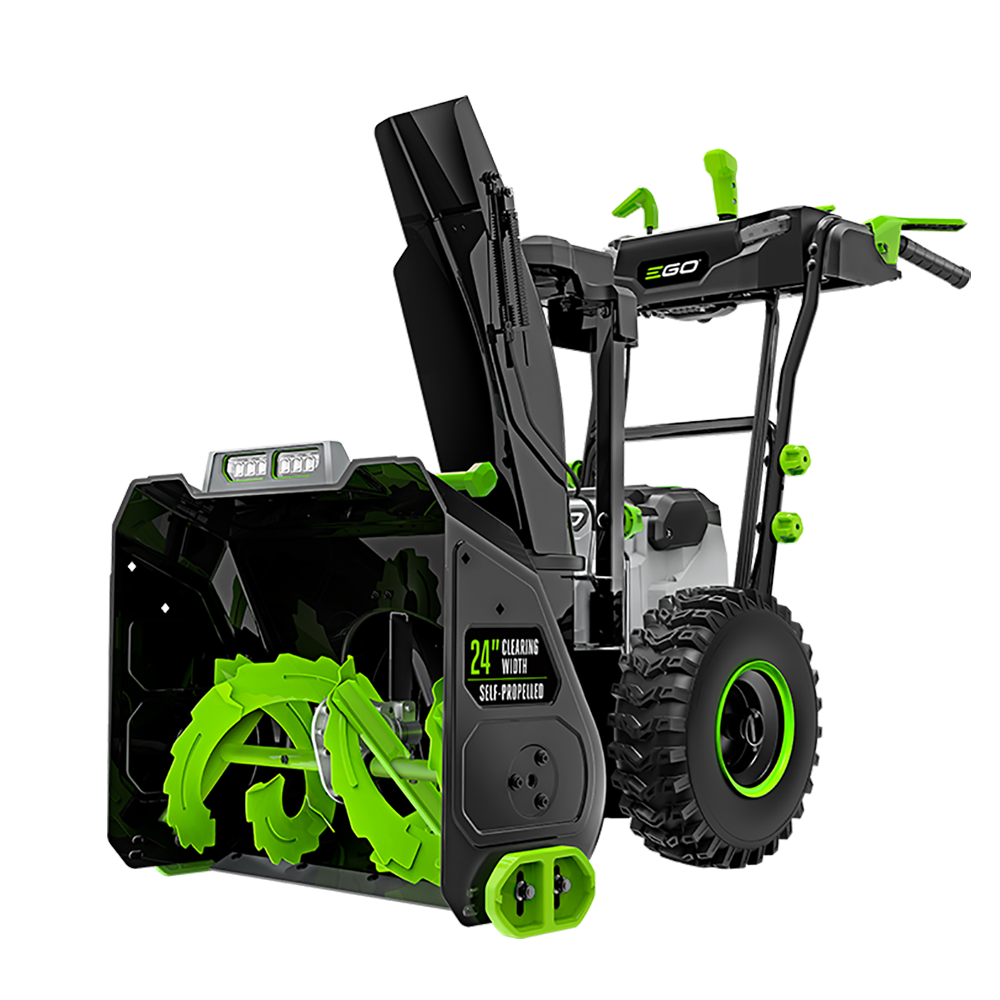
24" wide · 56V 7.5Ah × 2 (Peak Power) · 143 lb
The SNT2405 was the first battery two-stage that felt like a real gas replacement, and with 4.5 stars across nearly 6,000 Ace reviews it has aged well. Independent motors run the drive and steel auger, reverse is genuinely useful on a 143-lb machine, and the 50-foot throw claim is only mildly optimistic in dry snow. The blunt part from owners: the 18-car-driveway runtime claim is powder math. In heavy wet snow one reviewer barely finished a one-car, 50-foot driveway before both 7.5Ah packs quit — figure 30-45 minutes of real work, and budget a second battery set (about $430 each) for long driveways. Packs stored warm indoors shrug off cold mornings; frozen ones sag until they warm. Notably missing at $1,649: heated grips, which Ryobi's Whisper 24 includes for similar money. Versus Toro's 60V Power Max e24 it's the more proven machine with a deeper battery ecosystem; versus an Ariens Compact 24 gas unit you pay roughly $500 extra for push-button silence and zero engine upkeep. For 8-12 inch storms on a 2-3 car driveway, it's the sweet spot of EGO's line.
Best for Suburban homeowners with 2-3 car driveways and 8-12 inch storms who want gas-class two-stage power without the engine upkeep.