Buying guide
Buying Used, the Honda Exit, and Who Actually Makes Your Snow Blower
The used market is where snow blower money goes furthest — a ten-year-old Ariens outclears a new budget machine at half the price — and where the expensive mistakes hide under fresh paint and a seller's 'ran last winter.' Here's the driveway inspection that takes fifteen minutes, the state of the brand landscape now that Honda has left the building, and the honest synthesis for the first-winter buyer staring at all of it.
The fifteen-minute used inspection
Cold start first — insist the seller NOT warm it up before you arrive ('ran when parked' and 'starts when pre-warmed' hide the same carburetor problems), and a machine that fires within a few pulls cold has passed the most predictive test available. Then the drivetrain: rock each auger by hand feeling for shaft play (a little is fine, clunking is a bearing), spin the impeller checking it doesn't contact the housing, and grab the wheels to feel for axle slop. Check the friction disc drive by rocking the machine in gear — it should resist; a machine that rolls freely in gear needs a $30 disc and an hour, which is fine IF priced accordingly. Look underneath: the scraper bar and skid shoes are wear-item cheap, but a bucket edge rusted lacy or an auger housing flexing by hand is structural and terminal. Finally the gearbox: wiggle the auger shafts vertically — grinding or excessive play in the gearcase is the one repair that totals old machines.
Pricing sanity from the classifieds' long consensus: a healthy 5-10 year old two-stage from a serious brand runs 40-60% of its new price; 'needs carb work' means subtract $75 and a Saturday (usually true and usually easy per our maintenance guide); anything described as 'ran last year' but won't demo today prices as a parts machine. The best used inventory appears in April (movers, upgraders, spring cleaners) at the year's worst prices for sellers — the patient buyer's season — while October listings price like the sellers can smell the forecast.
The Honda exit and the badge-engineering map
Honda stopped making snow blowers, and the aftermath has two honest halves. Parts and service: fine for years — Honda's parts network runs long tails, the HSS machines share components broadly, and the engines are the most cloned design on earth. Prices: the used market decided Hondas are collectibles, with clean HSS two-stages now trading above what they cost new, which is fan-club economics, not clearing-performance economics — a same-money Ariens Platinum out-throws the shrine piece and comes with a warranty. Buy a used Honda if one surfaces at pre-exit prices from a seller who doesn't follow the market; skip the auction fever.
The rest of the badge map, plainly: Cub Cadet, Troy-Bilt, and Craftsman are all MTD (now Stanley Black & Decker) — the same platforms in different paint and trim tiers, which is why the forums treat them as one brand with three price points; buy whichever is discounted, judged on engine and build gauge rather than badge. Ariens and Toro remain the two real independent heavyweights, and the honest split the brand-war threads converge on: Ariens wins on steel gauge, gearbox reputation, and brute simplicity (the 'grandpa's machine still runs' brand); Toro wins on clever engineering that actually works (the Anti-Clog System, joystick chutes, superior single-stages) and lighter handling. Neither is a mistake; the tiebreaker is which dealer is five minutes from your house in a blizzard — dealer proximity is the most underrated spec in the category. Below all of them, the no-name Amazon two-stages save $300 up front and cost it back in tin-gauge steel, orphan parts, and second-winter listings on Facebook Marketplace.
The first-winter synthesis (and the tiny-driveway answer)
For the new homeowner drowning in the option tree, the decision collapses to three questions. Snow: under ~8 inches typical storm and paved — a quality single-stage (or a serious battery single-stage) is genuinely enough and stores in a closet's worth of space; over that, or any plow-pile exposure, two-stage. Driveway: two+ cars or 60+ feet earns the 28-inch class; gravel mandates two-stage full stop (single-stages eat gravel — our gravel FAQ covers the setup). Budget: the used-Ariens-for-$500 play from the previous section beats a new $700 badge-engineered machine every time someone's willing to do the fifteen-minute inspection; the new-with-warranty premium is worth paying when you aren't.
The townhouse/HOA case gets its own honest answer because the standard advice overserves it: a 20-foot pad and a sidewalk don't need a 250-pound two-stage that eats a third of a one-car garage. The right ladder: a $60 ergonomic shovel (genuinely sufficient more often than the category admits), an electric shovel or compact battery single-stage (closet-storable, instant-start, silent enough for 6 a.m. HOA peace), and only then a full machine. Vertical storage is the tiebreaker feature battery single-stages quietly win — several fold and hang on a wall like a bike, which in a packed garage is worth more than two inches of clearing width. And run the plow-service math honestly before any purchase: at $40-60 per visit, light-winter regions can buy years of service for one machine's price — the machine wins in heavy-snow country, at 6 a.m. schedules, and for everyone who's ever waited for a no-show plow guy with a flight to catch.
Units mentioned in this guide

Ariens Deluxe 28
~$1,64928" wide · 50 ft throw · 233 lb
The Deluxe 28 is Ariens' best-selling size and the machine you see chained down on half the trailers in Wisconsin every November: a 28-inch steel bucket, 14-inch auger and impeller, cast-iron gear case, and the 252cc AX engine, at a price that undercuts the SHO version by about $150. For most storms it's all the machine anyone needs — owners report 8-10 inch clearings at near-top gear and honest 40-50 foot throws in dry snow. The catch the forums flag: it shares its 252cc engine with the Deluxe 24, so those four extra inches of bite come out of your speed in wet, deep snow — if you regularly get slop, the 28 SHO's 301cc is the smarter $150. Auto-Turn makes it pivot like a much smaller machine, and the new generation dropped weight to 233 lb, which owners with sloped driveways appreciate. Heated grips slid to the options list this generation, an annoying delete at $1,649. Against Toro's Power Max 828, the Toro's anti-clog and Quick Stick chute are slicker; the Ariens is the more overbuilt frame with better resale. The default big-driveway pick for average snow.
Best for Two-to-three-car driveways in average snow regions — maximum width per dollar in the Ariens line.
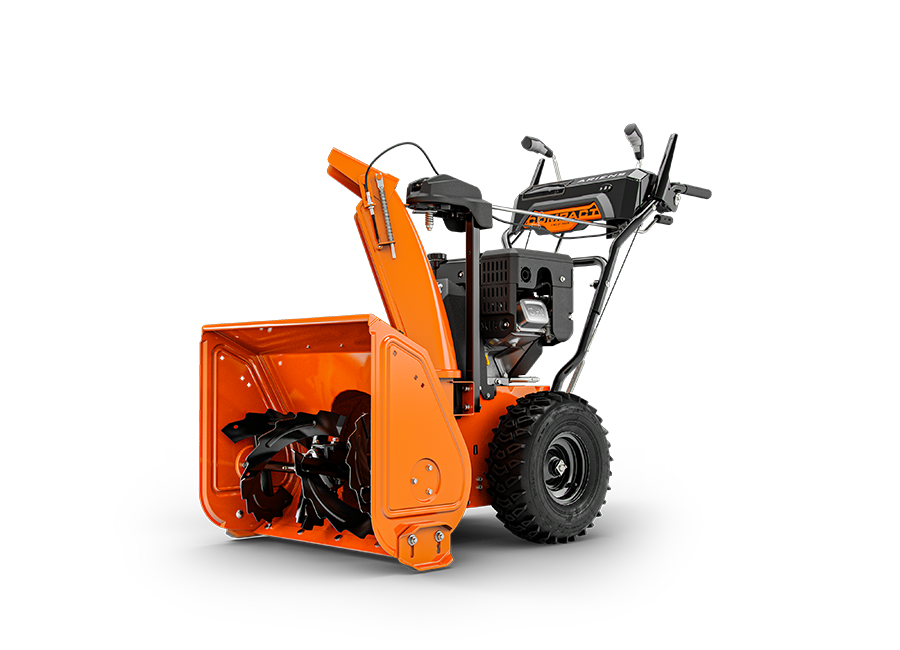
Ariens Compact 24
~$1,29924" wide · 40 ft throw · 187 lb
The Compact 24 is the cheapest way into a real Ariens two-stage, and the appeal is that the money went into the metal: all-steel bucket and dash, cast-iron gear case with a 5-year warranty, and the same Auto-Turn steering as the Deluxe line. Owners consistently call the build quality absurd for a $1,300 machine, and the 120V plug-in electric start means it fires on the first press in January. The honest knock is the 223cc engine — forum owners report it bogs in deep, wet snow at anything above the lowest speeds, and it's noticeably happier in fluffy powder than in the slush a plow leaves at the end of the driveway. At 187 lb with a 20-inch intake it's genuinely maneuverable, which is why it sells to people with one- or two-car paved driveways in moderate-snow states. Against a Toro Power Max 824 OE, the Toro clears wet snow with less drama, but the Ariens is the sturdier machine you'll still be running in 20 years. Buy it for the frame, drive it a gear slower in the heavy stuff.
Best for One- to two-car paved driveways in moderate snow regions where build quality matters more than raw wet-snow power.

Cub Cadet 2X 26 IntelliPOWER
~$1,30926" wide · 40 ft throw · 270 lb
The 2X 26 IP is the volume seller of Cub Cadet's two-stage line — same 243cc IntelliPOWER engine as the 2X 24 pushing a 26-inch bucket, which is the sweet spot most people actually need. Home Depot owners rate it 4.0 over 300+ reviews: they love the easy starting, 40-foot throw in cold powder, and the trigger steering; the recurring gripe is that the 243cc runs out of breath in deep wet snow at full width, and the chute can clog with heavy slush — a handful of reviewers flat-out say it doesn't handle soft wet snow well. That's the trade the spec sheet hides: Ariens puts a 254cc on its 24-inch Deluxe, so Cub is spreading similar power across two more inches. The owner-forum take is consistent — Cub Cadet buys you more features per dollar (power steering, tall intake, LED lights), Ariens buys you a burlier gearbox and impeller for the long haul. For a typical suburban 2-3 car driveway that sees mostly under-a-foot storms with the occasional dump, this is a lot of machine for ~$1,300, and the 5-year gearbox warranty softens the MTD-durability worry.
Best for Suburban owners with a 2-3 car driveway who want maximum width and features under $1,400.