Buying guide
What a Snow Blower Really Costs: Price Tiers, Maintenance, and When a Plow Service Wins
Snow blower pricing runs from a $170 corded electric to a $4,000-plus Honda, and the market is engineered to make the middle confusing: machines that look identical on the showroom floor separated by $600 that's entirely in the gearbox, the steering, and the decade of service life you can't see. Add the running costs nobody mentions and the plow service you could hire instead, and the real question isn't 'which snow blower' — it's 'what does clearing snow cost per year, by each route, honestly'. Here's that math.
The tiers, priced honestly
| Tier | Price | What you actually get |
|---|---|---|
| Corded electric (Snow Joe SJ627E class) | $170-$260 | Sidewalks and small pads; zero maintenance, one extension-cord argument per storm |
| Battery single-stage (Toro e21, EGO 21") | $500-$900 w/ batteries | The new default for small paved driveways; push-button everything |
| Gas single-stage (Toro Power Clear 721 E) | $480-$750 | More throw and runtime than battery at the price; carb care required |
| Budget gas two-stage (Troy-Bilt Storm 2425 class) | $800-$1,100 | Real two-stage capability, MTD-grade components and lifespan |
| Quality two-stage (Ariens Deluxe 24, Toro 826 OHAE, Cub 2X) | $1,300-$1,600 | The buy-once class: cast-iron gearcase, real steering, dealer support |
| Premium (EFI, tracks, hydrostatic, 30"+) | $1,700-$3,000 | Snowbelt features: track drive, big displacement, no-choke EFI starting |
| Honda class (HSS928 and up) | $2,800-$4,300 | Hydrostatic drive, GX commercial engines; wheel models ~$2,800, tracks $3,599+ |
Two honest notes on the table. First, the $800-$1,100 tier and the $1,300-$1,600 tier are where most buyers stand paralyzed, and the gap between them is the most consequential $500 in the market — the next section is entirely about it. Second, prices bounce seasonally by 20-40%: that Toro 721 E listing at $749 sold for $479 in a February clearance, and January-2026 deal threads had EGO's $1,649 two-stage at $1,119. The calendar section below is worth real money.
What the jump from $900 to $1,500 actually buys
The $800-$1,100 two-stage shelf at the big-box store — Troy-Bilt, Craftsman, and most Cub Cadet, all built by MTD — gets you a machine that genuinely works: a 208-243cc engine, a functional auger and impeller, electric start. What it doesn't get you is the stuff that determines year ten: stamped and welded gear cases instead of cast iron, bushings where the better machines run bearings, thinner bucket steel, and no steering assist — you muscle the machine through every turn. Owner experience puts these machines at a 5-10 year service life with care, and the aftermarket parts situation gets thin as models churn.
The $1,499 Ariens Deluxe 24 — the machine owner forums reflexively recommend when someone asks 'what should I actually buy' — spends the difference in specific places: a 254cc engine that clears the 10cc-per-inch bar, a cast-iron auger gearbox, a 14-inch impeller that throws visibly farther, Auto-Turn triggerless steering that removes the wrestling match, a 3-year warranty, and a dealer network that stocks parts for machines old enough to vote. Toro's Power Max 826 OHAE ($1,549-$1,599) makes the same argument with its anti-clog system and Quick Stick chute. These are 15-25 year machines — the forums are full of 1990s Ariens still working — so the per-year math typically favors the expensive machine: $1,500 over 20 years beats $900 over 7. The catch is you have to stay in the house long enough to collect, though quality machines also hold resale value the MTD builds don't.
Running costs: the drip nobody budgets
A gas two-stage in a normal winter burns maybe 5-10 gallons of fuel ($20-$40 — and make some of it ethanol-free, which costs more per gallon and saves you a carburetor), an annual quart of 5W-30 ($10-$15), a bottle of stabilizer ($10), and a few shear pins ($10 for spares you should already own). Add a drive belt every handful of years ($20-$40) and skid shoes and scraper bar wearing like brake pads. Do your own fall service and it's $60-$100 a year; hand it to a shop and a preseason tune runs $100-$200. None of it is optional in the long run — the deferred version of this list is called 'my snow blower won't start' and costs more.
Electric flips the sheet. A corded machine's running cost is literally pocket change of electricity. A battery machine's is pennies of charging plus one deferred liability: replacement packs at $300-$600 each (EGO's 10Ah retails at $549), typically due somewhere in years 5-10. Amortized, call battery ownership $50-$100 a year in eventual pack cost — real, but comparable to the gas drip, with all of it deferred and none of it involving a carburetor.
The plow-service math
Residential plow visits run $30-$70 for a normal driveway (call it $50), and seasonal contracts in most markets run $200-$700. Now the arithmetic splits by climate. Short-season country — 6 to 10 plowable storms a year — means $300-$500 annually by the visit, or one modest contract. Against a $1,500 machine plus running costs plus your labor at 6 a.m., the service takes 3-4 years just to break even, and the machine spends 350 days a year as garage sculpture. In these climates the service usually wins, and the honest recommendation for a marginal-snow region is a contract plus a $250 single-stage for touch-ups.
Snowbelt country inverts it: 25-40 plowable events means $1,200-$2,000 a year in visits, so the Ariens pays for itself during its first winter and then runs another 15 years. Ownership also fixes the service's two structural flaws — timing (the plow guy arrives on his route's schedule, which is rarely before your 7 a.m. departure, and everyone's berm gets plowed in at once) and finish (a truck plow clears a lane; it doesn't do the walkway, the mailbox, or the apron corners). The service's structural win is that nobody in your house has to be able to run a 250-pound machine in a storm — which, for plenty of households, is the whole decision. Run your own numbers: storms per year × $50, versus (machine ÷ 15 years) + $80. The crossover sits right around a dozen storms a year.
The calendar is real: when to buy
Snow blowers have a genuine price calendar. September and October are full price but full selection — the move if you want a specific quality machine, and dealers will actually assemble, test, and support what they sell you. December during the season's first storm is the worst possible moment, which is precisely when the most machines sell. The deals live at the edges: February-March clearances run 30-50% off as retailers dump floor space (that $479 Toro 721 E was a February price), and Presidents Day is a reliable event — but by March you're choosing from leftovers, so it's a strategy for the flexible, not the specific.
The best version of the calendar play: buy your next machine at the end of the season before you need it, store it dry, and start the winter ahead. The used market obeys the same rhythm — spring listings from people who just moved south are where old Ariens and Honda machines with decades left go for $300-$600, and 'buy a 20-year-old Ariens over a new MTD at the same price' is a legitimate owner-forum school of thought.
Buy-once-cry-once, quantified
Run the two philosophies side by side over 20 snowbelt years. Replace-every-cycle: a $900 budget two-stage lasting 7 years means three machines, roughly $2,700 in 2026 dollars, plus more repair drama and at least one mid-storm failure per machine's decline. Buy-once: $1,499 for the Ariens, maybe a belt, a couple of tune-ups, still running at year 20 — call it $2,000 all-in, with better steering, better throwing, and better starts the entire time. The premium machine is cheaper and better; it merely demands the cash up front.
The qualifier that keeps this honest: that math only holds where the machine works hard. In a 6-storm-a-year climate, the $900 machine will also last 15 years because it barely works, and the Honda-class purchase never pencils at all — the $3,599 HSS928 track machine is a snowbelt, steep-driveway, 40-storm tool, not a suburban flex. Match the spend to the winters. Cry once, but only if you actually live somewhere worth crying about.
Units mentioned in this guide

Troy-Bilt Storm 2425
~$1,22924" wide · 40 ft throw · 208 lb
The Storm 2425 is Troy-Bilt's entry two-stage and one of the cheapest name-brand paths to real auger-and-impeller snow clearing. The formula is simple: a 208cc engine, 24-inch bucket, 20-inch intake, and the Just One Hand control layout that lets you adjust the chute mid-pass — a feature bargain machines skip. Owner sentiment on the Storm line is steady rather than glowing: it starts easily, handles 8-12 inch storms fine, and the lifetime chute warranty is a nice touch, but the 208cc is the smallest engine you'll find pushing a 24-inch bucket, so wet heavy snow forces half-width bites, and there's no power steering, headlight, or heated grips at $1,229. The owner-forum framing is blunt: this is an MTD value machine — the same bones as a Craftsman 24 — so buy it for the price and the dealer network, not for heirloom durability; an Ariens Compact 24 costs ~$100-200 more and out-muscles it with a 223cc and better build. For light-to-moderate snow regions where the driveway is two cars and the budget is firm, it's a sensible, honest workhorse.
Best for Budget buyers in moderate snow regions who want name-brand two-stage basics on a two-car driveway.

Ariens Deluxe 24
~$1,49924" wide · 50 ft throw · 246 lb
The Deluxe 24 is the machine owners tell people to buy when they ask 'what's the safe choice?' — and the current 921069 keeps that formula: 252cc AX engine, a big 14-inch auger AND 14-inch impeller (most 24s run 12-inch impellers), dual-belt drive, and a 21-inch-tall steel bucket that swallows EOD piles. Owners love that it throws heavy snow a real 40-50 feet and that the cast-iron gear case is basically lifetime hardware. The eternal comparison is Toro's Power Max 826 OXE: the Toro is ~50 lb lighter with slicker chute controls and an anti-clog system, while the Ariens counters with a steel chute, sturdier frame, and better distance. Knocks are real but minor — Auto-Turn can wander on rutted gravel until skids are dialed in, heated grips are no longer standard on the Deluxe line, and several Home Depot reviewers report factory bolts backing out early ('torque everything before first use'). It's the default pick for two-car driveways in serious snow country, and resale is the best in the class.
Best for Two-car paved driveways in snow-belt states — the do-everything 24-inch that handles wet Nor'easter loads without drama.
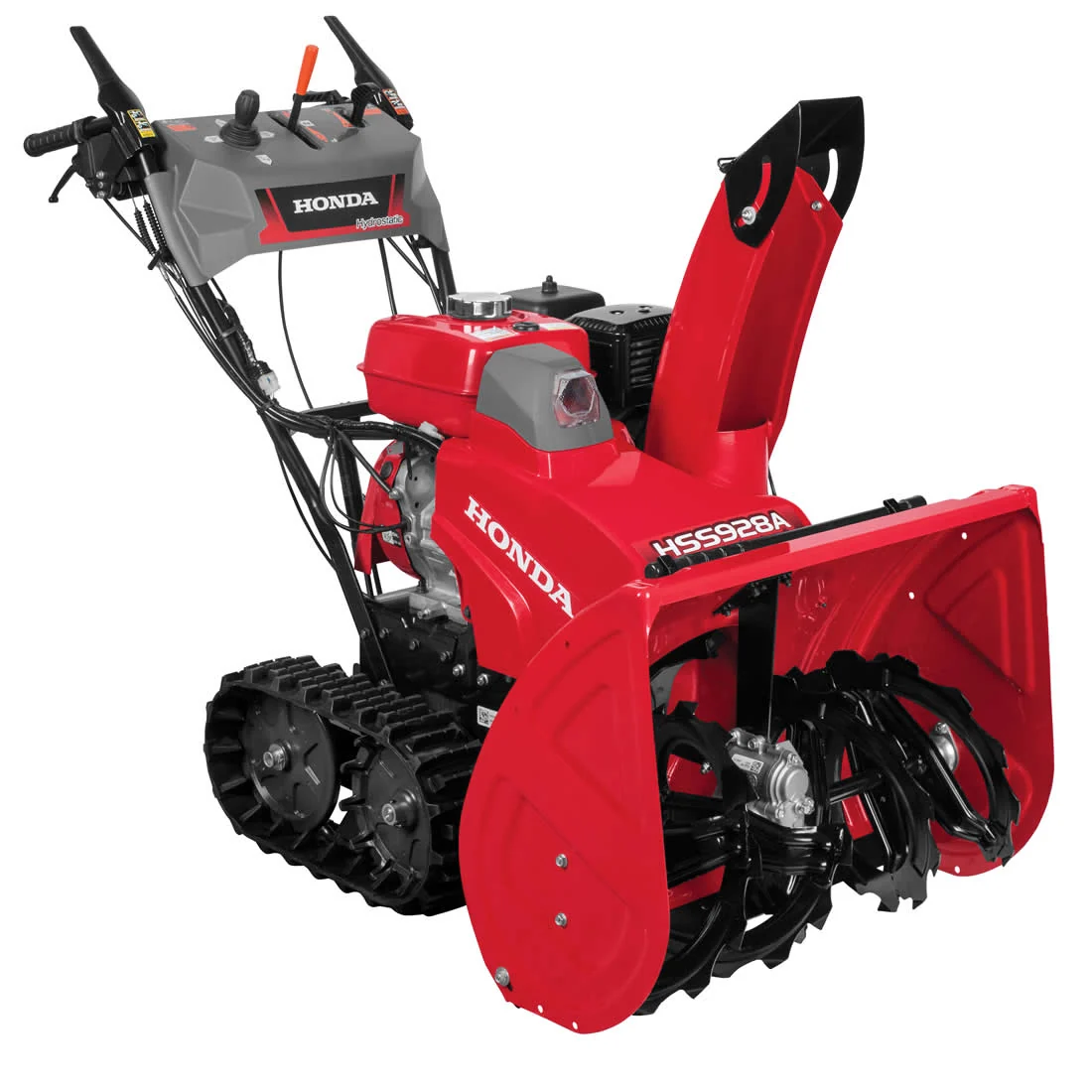
Honda HSS928ATD
~$3,59928" wide · 52 ft throw · 276 lb
The HSS928ATD is the Goldilocks of Honda's track line and the model snowblowerforum lifers usually mean when they say 'just buy the Honda': a GX270 pushing 1,900 lb/min through a 28-inch bucket, hydrostatic tracks that hold a grade like a tank, and joystick chute control that owners describe as fantastic. Home Depot reviewers call it 'easily the best snowblower made,' and the engine routinely outlives the driveways it clears. Honesty file: this platform was at the center of the HSS wet-snow clogging saga — Honda's redesigned larger-opening chute (free under warranty, standard on current units) mostly settled it, but heavy slush can still slow the 270cc more than the bigger HSS1332. At about $3,599 it costs $1,300+ more than an Ariens Platinum 24 SHO and turns slower than Ariens' auto-turn wheels, yet nothing in the price class matches its traction or fit-and-finish. With Honda winding down parts of its US power-equipment line, grab one while dealer channels are still full.
Best for Heavy-snowbelt homeowners with sloped or gravel driveways who want a buy-once machine and can stomach the price.