Buying guide
Snow Blower Sizing: Width, Intake Height, and Why Bigger Isn't Always Better
Snow blower sizing has a furnace-brain problem: the instinct says buy the widest machine you can afford, and the instinct is wrong twice. Width without engine behind it is the classic budget-brand trap — a machine that's slower than a smaller one because it bogs in anything dense. And width you can't maneuver, store, or fit through the shed door is a tax you pay every single use. The number that actually predicts performance isn't inches of bucket; it's engine cc per inch of bucket. Here's the sizing math, honestly.
The width math is less dramatic than the marketing
Clearing width determines the number of passes, and the arithmetic is humbler than the showroom implies. A typical two-car driveway is about 24 feet wide: with real-world overlap, a 24-inch machine crosses it in roughly 13 passes, a 30-inch machine in roughly 11. You paid hundreds of dollars more, added 50-plus pounds, and saved two passes — a few minutes — while every turnaround got slower because the machine got heavier. On small and medium driveways, turning time and maneuverability eat most of what width promises, which is why the 24-inch class is the perennial best-seller and the default owner-forum recommendation for suburban duty.
Width earns its keep on long, straight runs. A 150-foot rural driveway is a different job: each pass is 150 feet of walking, so dropping from six passes to five (24-inch vs 30-inch on a 12-foot-wide lane) saves a genuine 150 feet of trudging per clearing, multiplied by every storm all winter. The honest rule: width is a long-driveway feature. If your driveway is under 60 feet, buy width last — after engine, build quality, and intake height — not first.
Engine per inch: the number the budget brands hope you don't compute
Divide engine displacement by clearing width and the market sorts itself instantly. The machines the community actually recommends cluster right around 10cc per inch: the Ariens Deluxe 24 runs 254cc across 24 inches (10.6), the Toro Power Max 826 OHAE runs 252cc across 26 (9.7), the Honda HSS928 runs its commercial GX270 across 28 (9.6). The old-timers' version of the same rule — roughly 0.3 horsepower per inch of width, from the era when snow engines wore honest HP labels — lands in the same place. Below about 9, machines start to feel it in dense snow; meaningfully below that is the trap zone.
The trap looks like a deal: a big-box 28- or 30-inch machine at a 24-inch price, wearing an engine in the low 200s — 7-8cc per inch. In fluffy snow it's fine, and fluffy snow is what the demo video shows. In 8 inches of wet March snow, the engine can't keep the impeller at speed with a full bucket, so it bogs, the throw collapses from 30 feet to a sad dribble that lands back in your path, and you compensate by taking half-width bites — at which point your 30-inch machine is functionally a 15-inch machine that weighs 250 pounds. This exact experience, retold weekly on the forums, is why 'buy the biggest engine, not the widest bucket' is community canon. A strong 24 beats a weak 30 in every condition that matters.
Intake height vs your region's actual storms
Intake height — the vertical mouth of the bucket — sets the depth the machine can eat in one bite. Single-stage machines run around 12-13 inches on paper (less in practice); mainstream two-stage machines run 20-21 inches, like the Toro 826 OHAE's 20-inch intake. Match this to your region's real storm profile, not its record: if your big storms are 12-16 inches, any standard two-stage intake swallows them. You can clear deeper snow than the intake by taking it in layers, so an undersized intake costs time, not capability.
The wrinkle is that the deepest thing you clear all winter usually didn't fall from the sky. Plow berms and wind drifts stack higher than any single storm — a 10-inch snowfall can produce a 30-inch berm — and drift-prone open lots in the wind belt see the same. This is where tall-bucket machines and drift cutters stop being cosmetic, and it's a legitimate reason someone in Buffalo or Fargo buys a 28-inch-class machine even though their average storm would embarrass it.
Weight, storage, and the person actually driving it
A 24-inch two-stage weighs 200-250 pounds; big 30-inch machines push past 300. Self-propulsion moves the machine forward, but every turnaround, every correction, and every extraction from the snowbank you overran is the operator wrestling that mass — and the machine gets used by whoever's home when it snows, not just by whoever bought it. This is where features beat inches: Ariens' Auto-Turn and Toro's triggerless steering, which let the machine pivot without a wrestling match, do more for real clearing speed on an ordinary driveway than four extra inches of bucket ever will. If the primary operator is smaller, older, or has a bad shoulder, weight and steering belong at the top of the spec sheet.
Then the unglamorous constraint that vetoes more purchases than any spec: where does it live? Measure the shed door and the garage gap between car and wall before falling in love with a 30-inch bucket — machines that don't fit through the door get stored under a tarp, and machines stored under a tarp die young. A 24-inch machine fits through a 32-inch man door; the big ones often don't.
Wheels vs tracks, and matching the surface
Wheels are right for most people: lighter, cheaper, vastly easier to pivot and to move around the garage in July. Tracks earn their premium in three situations — steep driveways, where wheels spin and a track machine holds the grade without sliding back onto your shins; gravel and dirt, where tracks float over the surface; and hard-packed or icy bases, where tracks bite. The price of admission is real money and real stubbornness in turns: Honda's track-drive HSS928ATD runs about $3,599 at dealers, roughly $800 over its wheeled twin, and Ariens' RapidTrak line carries a similar premium over the equivalent Deluxe.
Surface matching, condensed: paved and flat, any machine works — buy on the other criteria. Gravel means a two-stage with skid shoes raised so the scraper bar rides about three-quarters of an inch up (never a single-stage — it throws the driveway at your house), and poly skid shoes are a cheap upgrade that glides where steel shoes gouge. Steep plus snowy equals tracks, and it's one of the few cases where the expensive answer is simply the correct one.
The sizing table
| Driveway & region | Recommended class | The reasoning |
|---|---|---|
| 1-car paved, storms under 8" | 21" single-stage | Faster than a two-stage at this scale; stores in a corner |
| 2-car paved suburban, plowed street | 24" two-stage, ~250cc (10cc/inch class) | The default answer: Ariens Deluxe 24 / Toro 824-826 territory |
| 2-car, snow country (regular 12"+ storms) | 26-28" two-stage, 250-300cc | Intake and torque for depth; width still secondary to engine |
| Long rural drive, paved | 28-30" two-stage, 300cc+ | Width finally pays: fewer 150-foot passes per storm |
| Gravel drive, any length | 24-28" two-stage, skid shoes high | Never single-stage on gravel; tracks optional but excellent |
| Steep grade, any surface | Track-drive two-stage (Honda ATD / Ariens RapidTrak) | Wheels spin on grades; tracks hold — worth the premium here |
If you remember one thing: when torn between two machines, take the one with more engine per inch, not more inches. The wide-and-weak machine disappoints in exactly the storms you bought it for; the narrow-and-strong one just takes a couple more passes and never breaks a sweat.
Units mentioned in this guide
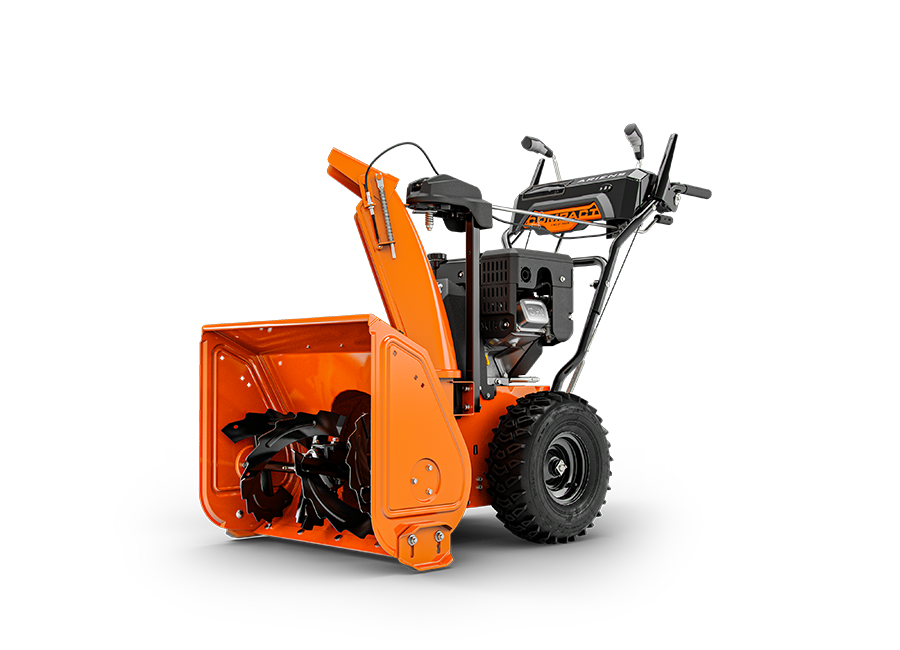
Ariens Compact 24
~$1,29924" wide · 40 ft throw · 187 lb
The Compact 24 is the cheapest way into a real Ariens two-stage, and the appeal is that the money went into the metal: all-steel bucket and dash, cast-iron gear case with a 5-year warranty, and the same Auto-Turn steering as the Deluxe line. Owners consistently call the build quality absurd for a $1,300 machine, and the 120V plug-in electric start means it fires on the first press in January. The honest knock is the 223cc engine — forum owners report it bogs in deep, wet snow at anything above the lowest speeds, and it's noticeably happier in fluffy powder than in the slush a plow leaves at the end of the driveway. At 187 lb with a 20-inch intake it's genuinely maneuverable, which is why it sells to people with one- or two-car paved driveways in moderate-snow states. Against a Toro Power Max 824 OE, the Toro clears wet snow with less drama, but the Ariens is the sturdier machine you'll still be running in 20 years. Buy it for the frame, drive it a gear slower in the heavy stuff.
Best for One- to two-car paved driveways in moderate snow regions where build quality matters more than raw wet-snow power.

Toro Power Max 826 OHAE
~$1,49926" wide · 45 ft throw · 194 lb · heated grips
The 826 OHAE is the sweet spot of Toro's two-stage line and the machine most often cross-shopped against the Ariens Deluxe - the forum verdict is that you can't go wrong either way, but the Toro's Quick Stick chute control beats Ariens' crank and it typically costs a few hundred less. Same proven 252cc four-stroke as the 824 OE, but the extra $100 buys the stuff you actually feel: triggerless Auto Steer that unlocks the inside wheel when you tip into a turn, hand warmers, an LED light for 6 a.m. storms, and a 26-inch bucket. The Anti-Clogging System meters intake so wet lake-effect snow keeps moving, and there are no shear pins - the engine stalls on impact by design, which owners initially distrust and later brag about. Honest knocks: 194 pounds is real weight when the drive is disengaged, friction-disc speeds need occasional cable adjustment, and the poly upper chute looks ordinary at this price. At $1,499 with a 45-foot throw and 20-inch intake, it's the default recommendation for anyone clearing a four-plus car driveway in serious snow country.
Best for The snow-country homeowner who wants the full comfort package - auto-steer, heated grips, headlight - at the mid-tier price.
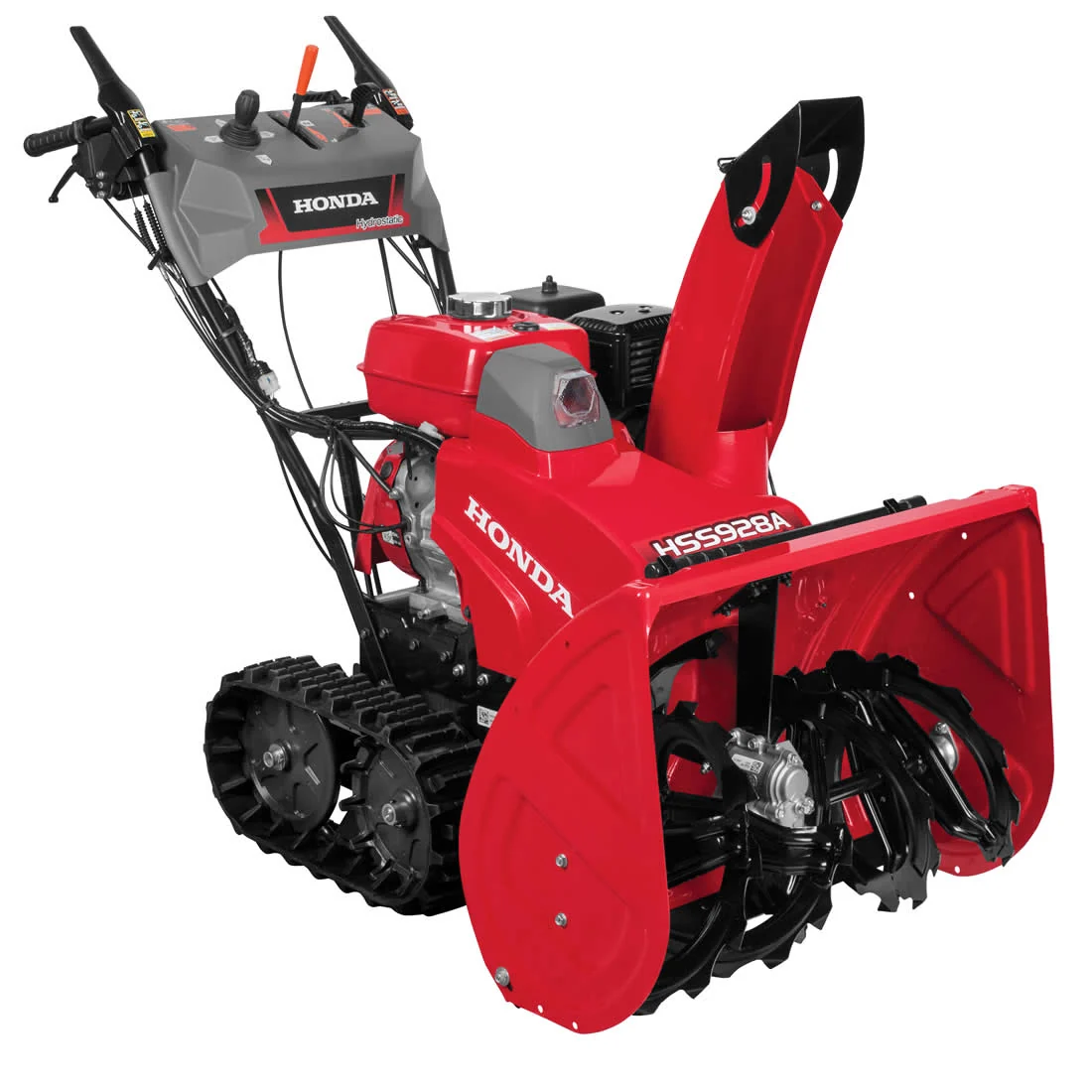
Honda HSS928ATD
~$3,59928" wide · 52 ft throw · 276 lb
The HSS928ATD is the Goldilocks of Honda's track line and the model snowblowerforum lifers usually mean when they say 'just buy the Honda': a GX270 pushing 1,900 lb/min through a 28-inch bucket, hydrostatic tracks that hold a grade like a tank, and joystick chute control that owners describe as fantastic. Home Depot reviewers call it 'easily the best snowblower made,' and the engine routinely outlives the driveways it clears. Honesty file: this platform was at the center of the HSS wet-snow clogging saga — Honda's redesigned larger-opening chute (free under warranty, standard on current units) mostly settled it, but heavy slush can still slow the 270cc more than the bigger HSS1332. At about $3,599 it costs $1,300+ more than an Ariens Platinum 24 SHO and turns slower than Ariens' auto-turn wheels, yet nothing in the price class matches its traction or fit-and-finish. With Honda winding down parts of its US power-equipment line, grab one while dealer channels are still full.
Best for Heavy-snowbelt homeowners with sloped or gravel driveways who want a buy-once machine and can stomach the price.