Craftsman
Craftsman SB230 21" Gas
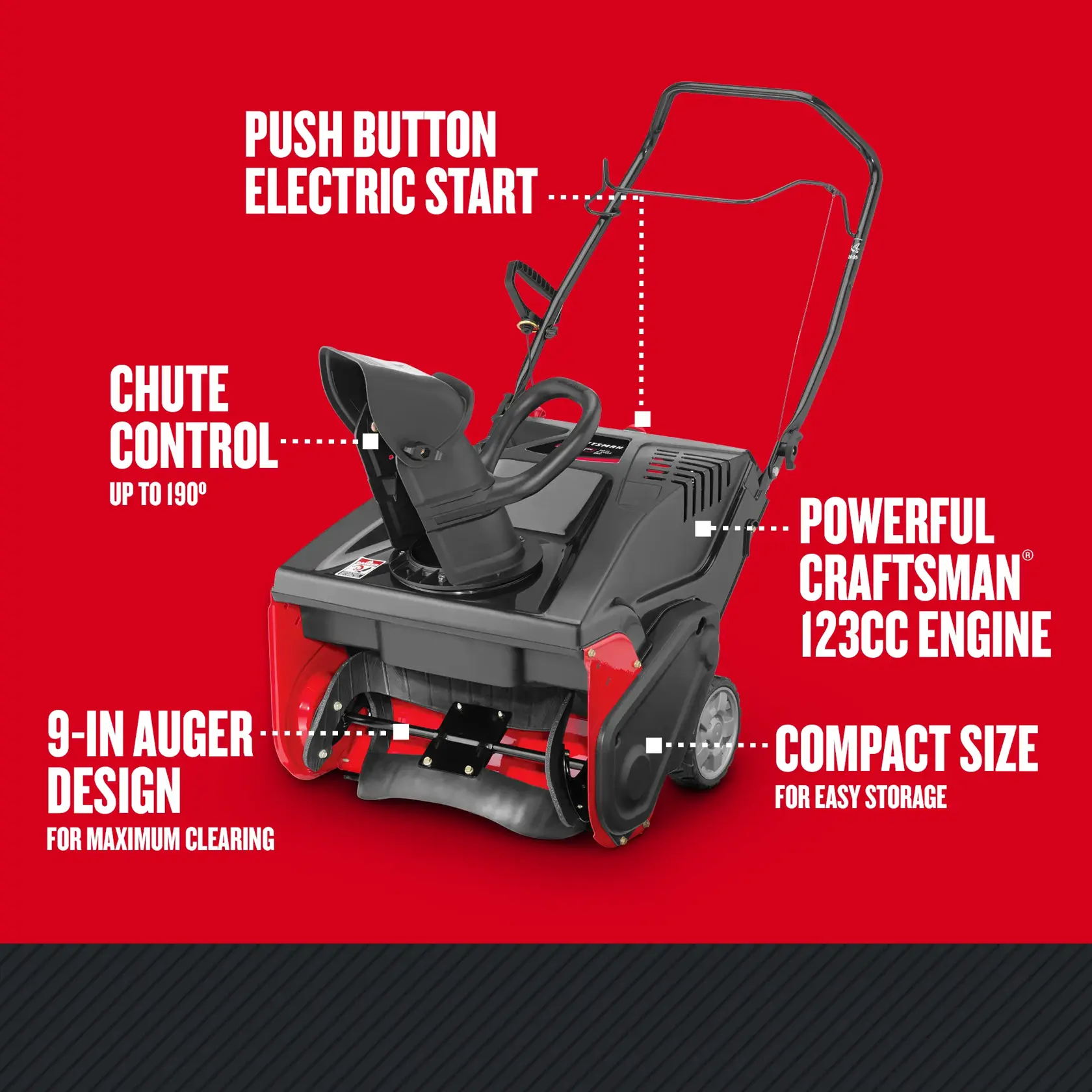
The SB230 is the budget-gas archetype: a 123cc 4-cycle OHV engine (no oil-gas mixing), push-button electric start so you skip cold-morning pull-cord roulette, and a 21x13-inch mouth that shrugs off the wet, heavy 6-8-inch storms that stall corded and battery single-stages — all for about $549, $250 less than a Toro Power Clear 721 E commands. Built by MTD in Tupelo, Mississippi, it's mechanically simple and the auger-assist pull genuinely lightens the pushing. The honest knocks from Lowe's owner feedback: out-of-box quality control is hit-or-miss (missing hardware, loose parts, and dead electric starters show up in reviews), the ~25-foot real-world throw trails a Toro's, chute parts are polypropylene, and finding warranty service for MTD-built Craftsman gear can be a runaround despite the 3-year coverage. There's no headlight either. If you get a good unit — most people do — it's years of cheap, gas-grade clearing for one-car driveways in serious snow; picky buyers should spend up for the Toro.
Single-stage machines scoop and throw in one motion, and the rubber auger touching the pavement means they scrape cleaner than anything else. Paved surfaces only, and they bounce off a refrozen plow berm rather than eating it.
Price and availability on Craftsman’s site may differ.
Specifications
No true self-propel, but the 9-inch rubber auger grips the pavement and pulls the 95-lb machine forward as it works — classic single-stage auger-assist. The 190° chute adjusts from a handle control. No headlight and no heated grips, so dawn clearing means a headlamp and good gloves.
Highlights
Pros
- ✓Cheapest name-brand gas snow blower with electric start (~$549)
- ✓4-cycle engine runs on straight gas — no premix, less winter fuss
- ✓Rubber auger-assist grips pavement and pulls the machine forward
- ✓13-in intake plus gas torque powers through slush and plow piles
- ✓190° chute control adjusts from the operator position
Cons
- ✗Owner reviews report spotty QC — missing parts and dead starters out of the box
- ✗95 lbs with no true self-propel gets tiring on slopes
- ✗No headlight or heated grips at a price where rivals add them
- ✗Gas upkeep is real: oil changes, carb care, and off-season stabilizer
- ✗Warranty service through MTD dealers can be slow and hard to find
Owner Insightssummarized from owner forums and reviews
The SB230 occupies a specific rung on the ladder: the cheapest way to put a real gas engine on your driveway when electric single-stages aren't cutting it. Sold through big-box stores with a 123cc four-cycle engine and push-button electric start, it's pitched at first-time snow blower buyers, and owner sentiment reflects that — people praise how approachable it is, how easily it starts, and how much machine they got for the money, while the experienced crowd files it under honest budget hardware rather than heirloom iron.
In practice it's a light-and-moderate-snow machine. Up to about 6 inches it clears a 21-inch swath quickly, the paddle-drive auger assist pulls it along smooth pavement, and it scrapes down to bare concrete the way good single-stages do. Push past that and its limits show: the paddles lose their grip in deep snow, wet storms shorten the throw, and the plow pile at the driveway's end is a shovel job. The other cost of gas is the ritual — owners who skip fuel stabilizer and fall draining report the classic stale-gas no-start the next season, and this carbureted engine is no exception.
It's best for a one-to-two-car driveway in a region with regular but not brutal snowfall, bought by someone who wants gas-engine grunt and cord-free range without paying two-stage money. The 3-year warranty is longer than most in the class, and the big-box parts channel keeps paddles and shave plates cheap and available — though warranty repairs route through service centers, not the returns desk. Owners who understand what a single-stage is, and treat the fuel system with respect, largely feel they got a fair deal.
What owners like
- +Real gas power at an entry price — owners treat it as the affordable step up when corded and battery single-stages run out of steam
- +Push-button electric start plus a recoil backup — owners call out skipping the cold-morning pull-start ritual as the feature that sold them
- +4-cycle 123cc OHV engine runs on straight gas — no two-stroke mixing, just fuel and go
- +Auger-assist propulsion: the rubber paddles grip the pavement and pull the machine forward, so on smooth surfaces you steer more than push
- +Light and compact for a gas machine — owners new to snow blowers say it's unintimidating to handle and easy to store
- +The 190-degree adjustable chute is simple and quick to redirect mid-pass
- +Scrapes cleanly to the pavement on smooth driveways, as single-stage paddle machines do best
- +3-year limited warranty — longer than most machines in its class — with parts and service reachable through the big-box channel it's sold in
Common complaints
- −It's auger-assist, not truly self-propelled — in deep or heavy snow the paddles lose grip and you're pushing a gas machine uphill
- −The comfortable ceiling is about 6 inches of snow; owners report deeper storms mean slow, partial-width bites
- −Classic carbureted-engine ownership applies: owners report no-starts after storage from stale fuel and fouled plugs, so fuel stabilizer and fall draining are mandatory homework
- −At least one owner reported a machine that quit starting after only a handful of uses — and warranty service means an authorized service center visit, not a swap at the store returns desk
- −Like every single-stage, it has no answer for the compacted plow berm at the end of the driveway
- −Wet, heavy snow cuts throwing distance sharply and can stall progress
- −The paddles and shave plate are wear items that need periodic replacement, a maintenance line-item electric owners never see
- −The modern Craftsman badge is budget-builder hardware — owners are clear it's a value machine, not the old-line Craftsman their parents owned
Common Questions
Is the Craftsman SB230 self-propelled?
How much snow can the SB230 handle?
Why won't my SB230 start after sitting all summer?
Is a Craftsman snow blower still good quality?
How does warranty and service work for a big-box snow blower?
Should I buy the SB230 or an electric single-stage?
Compare the Craftsman SB230 21" Gas
Related snow blowers
More from Craftsman →
22" wide · 30 ft throw · 93 lb
The 1022ER is the sleeper value in single-stage: Briggs' own 950 Snow Series 208cc engine — factory-rated to fire down to 20 below zero — in a 22-inch machine that undercuts an Ariens Path-Pro by a solid $120 while clearing an inch wider. Reviewers repeatedly note it 'works like a two-stage' in wet snow, which is the 208cc doing what the 123cc engines in cheaper single-stages can't, and the remote chute rotation (the 'R' in the name) means you're not stopping to muscle a chute like on the base 1022E. Owner gripes are specific: the thermoplastic auger leaves a thin film on ice-glazed pavement, a handful of owners report the drive belt walking off and being fiddly to re-seat, the manual is famously bad, and stock is genuinely hard to find some winters since B&S's 2020 restructuring thinned distribution. There's no headlight and nothing is heated. But for a sub-$700 machine handling 6-12 inch storms on a one-or-two-car paved driveway, it's the strongest honest-value play against the Toro Power Clear 721 E, which costs more for similar output.
Best for Budget-minded owners with one-to-two-car paved driveways and 6-12 inch storms who still want a big engine and remote chute.
Ariens Path-Pro 212
~$74921" wide · 35 ft throw · 95 lb
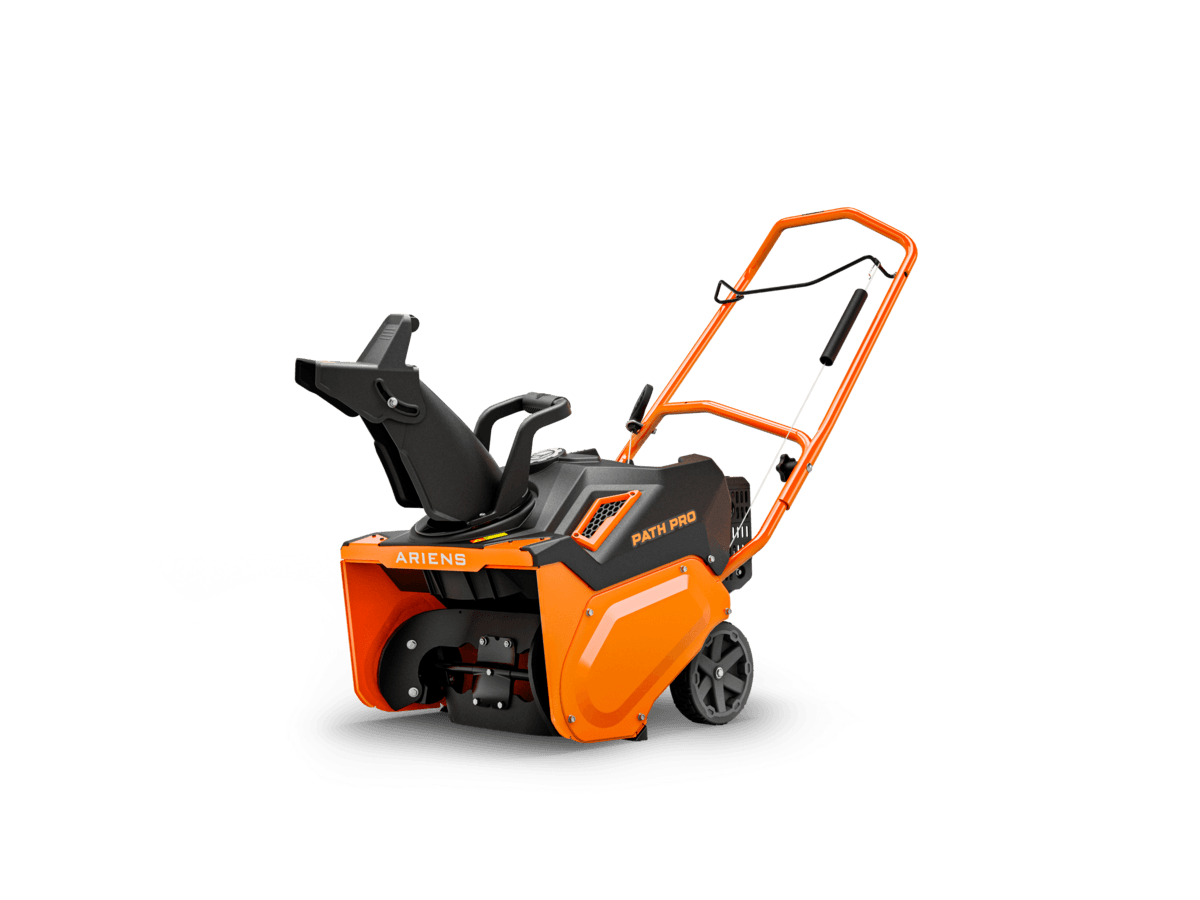
The Path-Pro is what happens when a two-stage company builds a single-stage: a 212cc AX engine that's big for a 21-inch paddle machine, a steel housing instead of the usual plastic tub, and an adjustable scraper bar. This is the current version. It replaced the 208cc Path-Pro SS21E (938032) with a 212cc engine and a restyled body, at the same $749 and the same 95 lb. Ariens rates it for up to 9 inches of snow and a 35-foot throw, the same throw Toro claims for the Power Clear 721 E, which runs 11 lb lighter with slicker controls for $50 more. Because the paddles pull it along, you walk it like a self-propelled mower and it scrapes clean to the pavement — this is the pick for decks, sidewalks, and one-car-wide city driveways. Honest downsides: at 95 lb it's one of the heavier single-stages, chute rotation is a manual handle unless you buy the remote-chute version (938037, $849), there's no headlight, and like all paddle machines it will bounce off anything deeper than a foot or the icy wall the plow leaves. If your snow is regular but rarely epic, it's a single-stage built to last.
Best for Sidewalks, decks, and one-car paved driveways with regular sub-foot snowfalls — the durable single-stage for people who hate disposable machines.

18" wide · 25 ft throw · 58 lb
Toro's entry-level gas single-stage is the machine owners recommend when someone's back gives out but their budget hasn't recovered: about $629, 58 pounds, and a 99cc Toro Premium OHV four-stroke that starts with a push-button (plug in an extension cord) or a single pull. The party trick is the Power Curve rotor - the curved rubber paddles scrape clean to pavement and actually pull the machine forward, so there's no drive system to maintain and no pushing to speak of. Owners love that it stores upright in a closet-sized footprint and tosses powder a legit 25 feet. The honest knocks: the chute handle lives on the chute, so you're reaching down to redirect mid-pass; 12 inches of intake height disappears fast in a real dump; and wet end-of-driveway slop will stall your progress if you take full bites. Against Ariens' Path-Pro 212 it gives up more than 100cc but costs less, weighs less, and draws strongly positive owner reviews. For a two-car paved driveway in a normal-snow city, this is the sane default.
Best for The city homeowner with a short paved driveway and sidewalks who wants gas reliability without gas bulk.

21" wide · 35 ft throw · 84 lb
The 721 E has quietly become the default 'just buy the Toro' answer for paved driveways - strongly positive owner reviews and a decade of the 212cc four-stroke proving itself. It throws snow up to 35 feet, starts with a push-button (via 120V cord) or first pull, and the Power Propel paddle drive pulls itself forward hard enough that you're steering more than pushing. The Quick Chute lever spins the 210-degree chute without stopping, and unlike the two-strokes of old there's no gas-oil mixing. Owners' complaints are specific: the chute lever is short and awkward for some hands, single-stage paddles ride up on hardpack and can't touch gravel, and a foot-deep wet storm means slow, half-width bites. Early units had scattered reports of the exhaust cooking a control cable, largely sorted in later production. At $799 the 721 E mostly competes with its big brother 821 QZE - buy the 721 if your snow is usually under 9 inches and your driveway holds four cars or fewer.
Best for The suburban homeowner with a 2-4 car paved driveway who wants the proven, no-drama gas single-stage everyone recommends.

21" wide · 25 ft throw · 98 lb
The Squall 208E is the heir to the long-running Squall 2100 — same 208cc/21-inch formula, at the top of Troy-Bilt's single-stage line. It's the practical pick for people who want real gas power in a machine one person can lift into a hatchback: 98 lb, folding handle, electric start, and a big-for-the-class engine that owners say chews through 6-8 inches without drama. Owner reviews are generally positive, praising the easy start and how the paddles pull it along; the knocks are classic single-stage — the 13-inch intake chokes in deep drifts, slush gets thrown feet not yards, and the E-Z Chute lever feels plasticky and can loosen over time. It's mechanically nearly identical to Cub Cadet's 1X 21 LHP (both MTD-built) but runs about $110 cheaper because it skips the headlight and the fancier remote pitch control. Against Toro's Power Clear 821 QZE, the Toro throws farther and its Quick Shoot control is slicker, but it also costs $200+ more. For paved 1-2 car driveways in moderate snow country, this is the value play in premium single-stages.
Best for Budget-minded owners of paved one- and two-car driveways who want the strongest engine in the single-stage class.

20" wide · 80V, 1×4.0Ah battery · 34 lb
This is Greenworks' answer to the Ego SNT2102, and at around $600 with a 4.0Ah battery and rapid charger it lands about $100 under the Ego kit. The brushless motor chews through 4-6 inches of powder without drama, the dual LEDs are genuinely useful, and if you already own Greenworks 80V mower or blower batteries the value gets silly. The honest limits: one 4.0Ah battery is good for roughly a 2-4 car driveway (30-45 minutes) in light snow, and that shrinks fast in the wet cement-grade stuff, where the 20-foot rated throw drops to a dribble that lands back in your path. Owners also note lithium packs sulk below about 10°F unless stored indoors. It's the right machine for a suburban driveway in a 3-8 inch snowfall climate — buy a second battery, or step up to a two-stage if your plow berm regularly tops a foot.
Best for Suburban homeowners with a 2-4 car driveway who want quiet cordless clearing and may already own Greenworks 80V batteries.