
Toro
Toro Power Clear 821 QZE
This is the biggest engine anyone puts in a single-stage - a 252cc Toro Premium OHV in a 95-pound, 21-inch machine - and it exists for people who want two-stage punch without two-stage bulk. Forum consensus on the 821-vs-721 question is refreshingly honest: it won't clear anything the 721 can't, but it's noticeably quicker through deep, dense snow and hurls slush up to 40 feet instead of dribbling it. The Power Propel paddles yank it forward aggressively (feather your grip on ice), electric start is push-button with a cord, and the Zip Deflector flips throw height with a palm tap. Knocks from the 631 owner reviews averaging 4.5 stars: it's front-heavy for a single-stage, the chute handle still requires a reach, and at $999 you're within sight of a real two-stage Power Max 824 on sale. Still no gravel, still 12.5 inches of intake. Buy it for wide city driveways with heavy plow drool at the curb; skip it if your snow is fluffy and occasional - the 721 does that job for $200 less.
Single-stage machines scoop and throw in one motion, and the rubber auger touching the pavement means they scrape cleaner than anything else. Paved surfaces only, and they bounce off a refrozen plow berm rather than eating it.
We may earn a commission.
Price and availability on Amazon’s site may differ.
Specifications
Highlights
Pros
- ✓Chews through deep, dense snow noticeably faster than the 721 E
- ✓40-foot throw distance rivals mid-size two-stage machines
- ✓Power Propel drive pulls it forward - your job is steering
- ✓Zip Deflector changes throw height with one touch
- ✓Electric start plus recoil; commercial-grade engine components
Cons
- ✗At $999 it overlaps discounted entry two-stage prices
- ✗Front-heavy - the nose dives on uneven pavement transitions
- ✗12.5-inch intake still limits it in foot-deep storms
- ✗Chute handle requires reaching down mid-pass
- ✗No gravel, no headlight, no hand warmers
Owner Insightssummarized from owner forums and reviews
The 821 QZE is the single-stage for people who want maximum capability without going two-stage, and owner sentiment is that it delivers: the 252cc engine has genuine grunt, working through heavy and wet snow decidedly faster than the smaller Power Clears. The Quick Shoot handle-mounted chute control is the feature owners rave about most — swinging the chute from the handlebar mid-pass rather than reaching to the chute changes how the machine feels to use.
Starting is a non-event — a three-pump prime and one pull, with plug-in electric start in reserve — and the big fuel tank runs a full storm. It clears plow buildup at the end of the drive and throws wet snow surprisingly far. The realistic caveats: the chute mechanism can freeze in severe cold until thawed, some owners have reported build-quality misses like loose shrouds and shipping damage on delivered units, and a handful have chased engine rattles. At about 98 pounds it's also the heavyweight of the single-stage class, though the engine's higher mount avoids the cable-melt issue owners flag on the 721.
It suits paved driveways up to two or three cars in snow-belt areas where storms are frequent but rarely exceed a foot. On value, it sits in a squeeze: meaningfully more money than the 721 E, and close to entry two-stage machines. Owners resolve it this way — if you want the fastest possible paved-surface clearing with premium controls and easy storage, the 821 QZE is the pick; if your snow is deep, drifted, or your driveway is gravel, put the same money toward a Power Max.
What owners like
- +The 252cc engine is roughly 25% larger than the 721's, and owners describe it as having decidedly more grunt — faster work of heavy and moderate snow alike
- +Handle-mounted Quick Shoot chute control lets you swing the chute without leaving the handlebar — owners who came from a 721 call it the killer feature
- +Fires on the first pull after a three-pump prime, idles smoothly, and the plug-in electric start is there as backup
- +Clears end-of-driveway plow buildup cleanly — owners report it eats wet snow and throws it as advertised
- +Far more maneuverable than a two-stage, and at about 98 pounds it's still light enough to load into a truck for a second property
- +The engine sits higher than on the 721, which owners note avoids the exhaust-melting-the-cable issue reported on its smaller sibling
- +Large fuel tank (about 3 quarts) gets through a whole storm without refueling
- +Scrapes paved surfaces to bare pavement while self-propelling on the paddles
Common complaints
- −Quality-control misses show up in owner reports: shrouds working loose, units arriving with gouges — inspect a delivered unit carefully
- −The chute and its remote control can freeze up in bitter cold; owners report it locking until thawed
- −A few owners have chased an engine knock or rattle under load, enough to generate multiple discussions
- −Priced close to entry-level two-stage machines, which forces a genuine decision if you get deep snow
- −Still a single-stage: rubber paddles and the scraper bar are wear items and gravel is off-limits
- −At nearly 100 pounds it's heavy for a single-stage — noticeably more effort to lift and turn than the 721
- −Deep storms much beyond a foot overwhelm any 21-inch single-stage intake, this one included
- −Some owners who received rough units say buying from a servicing dealer beats big-box delivery for setup and recourse
Common Questions
What does QZE mean and is the Quick Shoot control worth it?
How is it different from the Power Clear 721?
Can it handle end-of-driveway plow piles and wet snow?
Are there known problems to watch for?
Is it too heavy to be a single-stage?
Compare the Toro Power Clear 821 QZE
Related snow blowers
More from Toro →
21" wide · 35 ft throw · 84 lb
The 721 E has quietly become the default 'just buy the Toro' answer for paved driveways - 1,800+ reviews averaging 4.5 stars and a decade of the 212cc four-stroke proving itself. It throws snow up to 35 feet, starts with a push-button (via 120V cord) or first pull, and the Power Propel paddle drive pulls itself forward hard enough that you're steering more than pushing. The Quick Chute lever spins the 210-degree chute without stopping, and unlike the two-strokes of old there's no gas-oil mixing. Owners' complaints are specific: the chute lever is short and awkward for some hands, single-stage paddles ride up on hardpack and can't touch gravel, and a foot-deep wet storm means slow, half-width bites. Early units had scattered reports of the exhaust cooking a control cable, largely sorted in later production. Honda's exit from US snow blowers removed its only real single-stage rival, so at $799 the 721 E mostly competes with its big brother 821 QZE - buy the 721 if your snow is usually under 9 inches and your driveway holds four cars or fewer.
Best for The suburban homeowner with a 2-4 car paved driveway who wants the proven, no-drama gas single-stage everyone recommends.
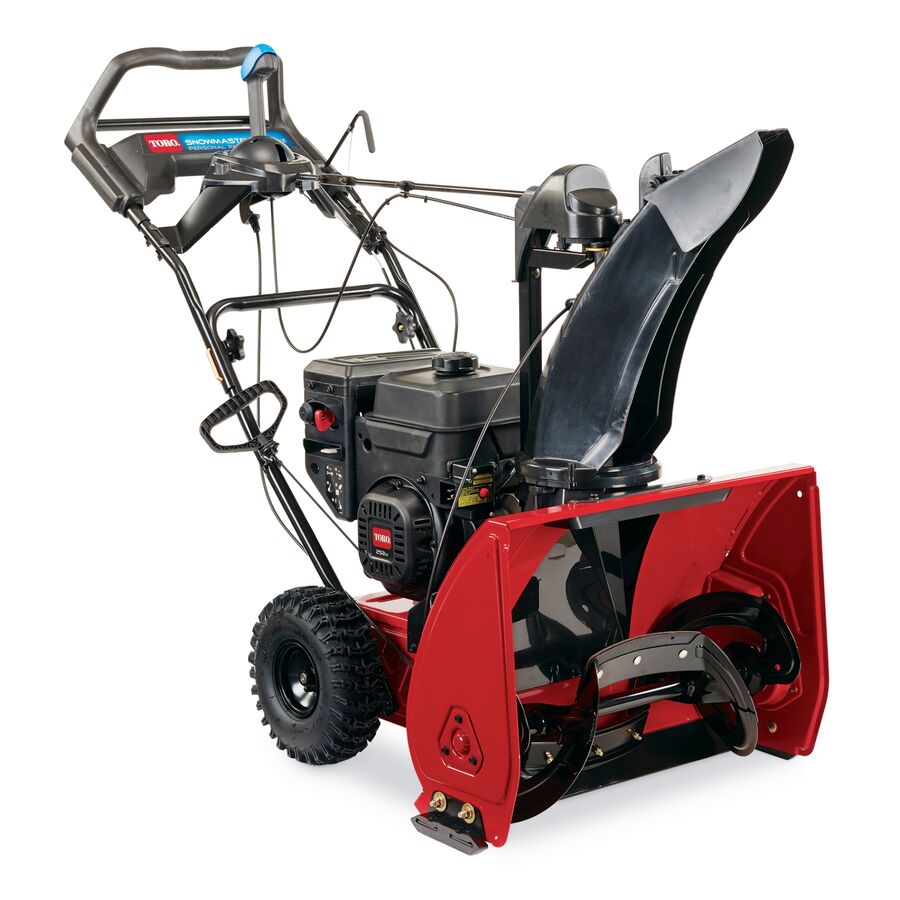
Toro SnowMaster 724 QXE
~$1,19924" wide · 40 ft throw · 125 lb
The SnowMaster is the line Toro built to answer a specific complaint: two-stage machines are slow and heavy, single-stages are too narrow. It takes a 24-inch bite like a two-stage but uses one in-line auger spinning roughly ten times faster than a conventional one, so snow goes straight out the chute instead of being handed to an impeller. The result is a machine that clears a two-car driveway at walking speed and still lifts onto a truck tailgate. The trade-off is honest and worth understanding before you buy: the rubber-edged auger contacts the ground, so this is a paved-surface machine only, and it will not touch a gravel drive. Against the Power Clear 821 QZE it clears three more inches per pass; against the Power Max 824 OE it gives up the ability to handle a packed end-of-driveway berm.
Best for Paved two-car driveways where the storms are frequent but rarely deeper than a foot, and speed matters more than brute force.
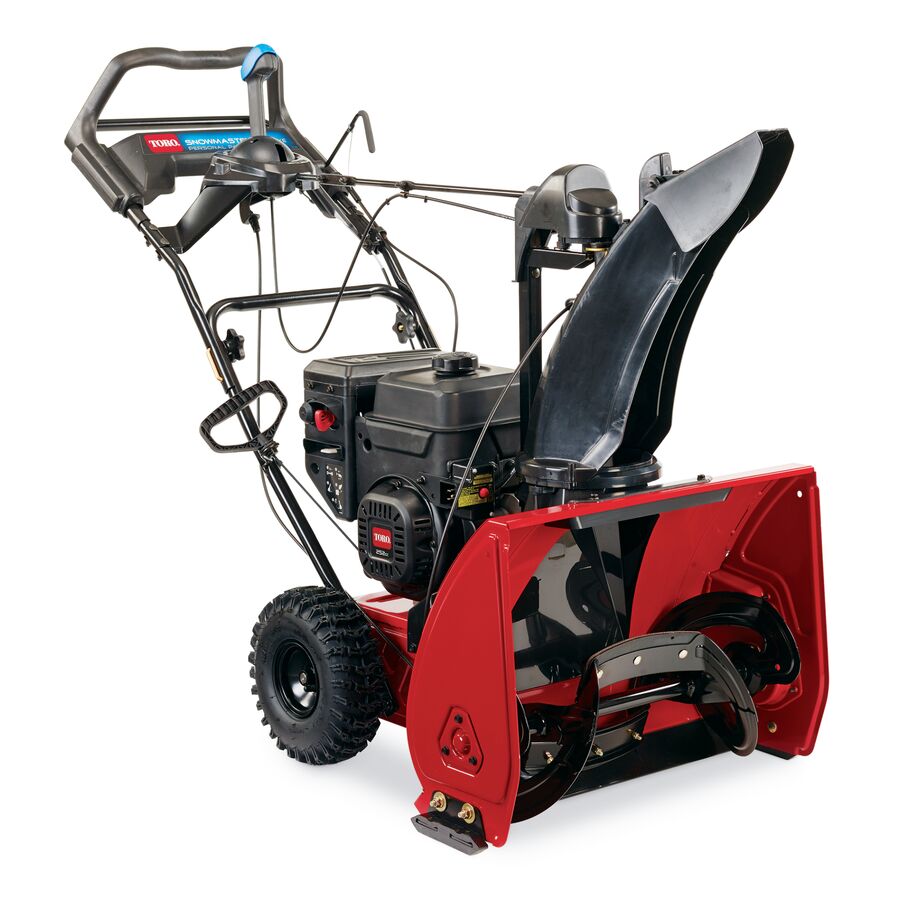
Toro SnowMaster 824 QXE
~$1,24924" wide · 40 ft throw · 131 lb
The 824 QXE is the 724 with a 252cc engine in place of the 212cc and six more pounds on the scale, and that is genuinely the whole difference. Same 24-inch in-line auger, same Personal Pace drive, same 18-inch intake. The larger engine is the answer to the SnowMaster's one real weakness — wet, heavy, late-season snow, where the smaller motor has to be driven slower to keep the auger spinning. For $50 more it is difficult to argue for the 724 unless the machine is going to live somewhere the extra six pounds matters.
Best for The same paved two-car driveway as the 724, in a region where the snow arrives wet and heavy rather than dry and light.

18" wide · 25 ft throw · 58 lb
Toro's entry-level gas single-stage is the machine owners recommend when someone's back gives out but their budget hasn't recovered: about $609, 58 pounds, and a 99cc Toro Premium OHV four-stroke that starts with a push-button (plug in an extension cord) or a single pull. The party trick is the Power Curve rotor - the curved rubber paddles scrape clean to pavement and actually pull the machine forward, so there's no drive system to maintain and no pushing to speak of. Owners love that it stores upright in a closet-sized footprint and tosses powder a legit 25 feet. The honest knocks: the chute handle lives on the chute, so you're reaching down to redirect mid-pass; 12 inches of intake height disappears fast in a real dump; and wet end-of-driveway slop will stall your progress if you take full bites. Against Ariens' Path-Pro 208E it gives up 100cc but costs less, weighs less, and carries a 4.5-star average across 1,600+ Ace Hardware reviews. For a two-car paved driveway in a normal-snow city, this is the sane default.
Best for The city homeowner with a short paved driveway and sidewalks who wants gas reliability without gas bulk.

21" wide · 60V 7.5Ah (405Wh) · 55 lb
Toro's battery single-stage is the rare cordless machine that gas people concede is legitimate - one six-season owner on Snowblower Forum called it flat-out better than his EGO and only a notch behind a gas 721 E. The 60V brushless motor ramps power with load, the Power Curve paddles scrape to pavement and pull the 55-pound machine forward, and it throws cold powder up to 40 feet. It's also quiet enough for 5 a.m. and starts with a bail squeeze - no cord, no choke, no carburetor to gum up over summer. The honest limits: the included 7.5Ah pack clears roughly an 8-to-12-car driveway of moderate snow, but wet heavy stuff can halve that, spare L405 batteries are painfully expensive, and the stubby chute's deflector is awkward to adjust mid-pass. At $749 it undercuts EGO's comparable kit while sharing packs with Toro's 60V mowers and trimmers, which is the whole ecosystem play. Over 1,000 Ace Hardware reviews average 4.5 stars. For paved driveways and storms under 10 inches, this is the future arriving politely.
Best for The suburbanite with a paved 2-4 car driveway who already owns (or wants) Toro 60V yard tools and is done with gas cans.

Toro Power Max 824 OE
~$1,39924" wide · 45 ft throw · 184 lb
The Power Max 824 OE is the price of entry to Toro's two-stage world and probably the best value in the lineup: $1,399 gets you the same 252cc engine as the flagship 826 trims, a 24-inch bucket with a full 20 inches of intake, and a legit 45-foot throw. Toro's Anti-Clogging System is the sleeper feature - it meters what the auger feeds the impeller, so heavy wet snow keeps flying instead of packing the chute - and there are no shear pins to snap; hardened gears plus an engine that deliberately stalls on impact stand in for them, which unnerves first-timers and delights everyone else. The Quick Stick joystick moves chute and deflector in one motion and is genuinely nicer than Ariens' crank. What you give up versus the 826 OHAE: no triggerless steering, no hand warmers, no headlight - and 184 pounds takes some muscle in turns. Against the Ariens Compact 24 (223cc), the Toro throws farther and clogs less; Ariens counters with auto-turn steering. Over 1,100 Ace reviews average 4.5 stars. The pragmatist's two-stage.
Best for The value-focused buyer stepping up to their first two-stage for a 4-10 car driveway who can skip heated grips and auto-steer.