
Toro
Toro 60V Power Max e24
The e24 is a real two-stage - friction-disc transmission, triggerless steering, Quick Stick chute, 20-inch intake - that happens to run on a pair of 60V packs, and that framing matters more than the marketing. With the included 2x6.0Ah batteries, owners report clearing a two-car suburban driveway of powder with charge to spare; instant torque means it never bogs the way small gas engines do, there's no warm-up, and maintenance is basically nil. The catches are the ones forums hammer: wet, heavy snow slashes both throw distance and runtime, the motor spins whenever the machine is switched on, and replacement packs run $300-plus - which is why the third battery port feels less like a luxury than a necessity for anything past 60 feet of pavement. At $1,599 it undercuts the e26 by $300 while giving up two inches of width, hand warmers, and the bigger 7.5Ah packs. Ace reviews average 4.0 stars - powder-country owners rave, wet-snow owners grumble. Best for single-width drives in cold, dry climates, ideally with a shovel or gas backup for the March cement.
Two-stage machines add an impeller behind a steel auger and ride on adjustable skid shoes: anything deeper than about eight inches, anything wet and heavy, gravel surfaces, and the compacted wall the city plow leaves at the end of the driveway.
Price and availability on Toro’s site may differ.
Specifications
Highlights
Pros
- ✓Instant electric torque holds impeller speed under load
- ✓No oil changes, carb cleanings, or fall tune-ups - ever
- ✓Triggerless steering and 172-lb build make it easy to handle
- ✓Quick Stick chute control carried over from gas Power Max line
- ✓Quiet enough to clear snow before the neighborhood wakes
Cons
- ✗Wet, heavy snow sharply reduces throw distance and runtime
- ✗Included 6.0Ah packs are smaller than the e26's 7.5Ah
- ✗Replacement 60V batteries cost $300+ each
- ✗No hand warmers on a $1,599 winter machine
Owner Insightssummarized from owner forums and reviews
The 60V Power Max e24 is the battery two-stage that long-term owners vouch for: the most-cited owner account is a three-season review concluding it's still running strong and calling it 'the real deal' — a serious machine without the headaches of gas. What separates it from lightweight electric pretenders is construction: steel where it matters, a genuine two-stage auger and impeller, and a chute that throws with authority.
The practical picture from extended ownership: push-button starts in any cold, quiet operation, and 40–60 minutes of real clearing with three batteries aboard depending on depth and density — with the strong recommendation to budget for that third battery and an extra charger, because the two-pack kit is marginal in bigger storms. The e24's solid axle is its signature quirk: both wheels drive constantly, so it climbs hardpack without spinning, but off-power it's a wrestle, and owners pass along a one-hand turning technique for pivoting it under power on slick pavement. Wet slush can briefly pack the cold chute — a quick clear and it's back to work.
It suits two-to-three-car paved driveways for owners who want two-stage capability with zero engine upkeep — and who go in clear-eyed that batteries are the real cost of ownership, at $300–400 a spare. Against its e26 sibling, the e24 trades the wider bucket and triggerless steering for a lower price and the always-locked axle traction. Against gas, the money math rarely wins; the silence, instant starts, and maintenance-free winters are what owners say they're actually buying.
What owners like
- +A three-season owner review reports it still running strong with zero gas-style maintenance — their verdict: a serious machine, 'the real deal'
- +It's built like a real two-stage — steel where it matters, a solid auger, and a chute that throws snow with authority, per long-term owner reports
- +With three batteries aboard, owners reliably get 40–60 minutes of clearing depending on snow depth and density — enough for large residential properties
- +Three onboard battery ports mean you can carry your entire runtime on the machine instead of swapping trips to the garage
- +The solid rear axle drives both wheels all the time, so it keeps traction climbing hardpack where single-wheel-drive machines spin out
- +Push-button instant start in any temperature — no priming, choking, or pull cords, which owners coming from gas call the biggest daily upgrade
- +QuickStick chute control puts snow exactly where you want it without stopping
- +Far quieter than gas two-stage machines — early-morning clearing without waking the neighborhood
Common complaints
- −Plan on a third battery and ideally a third charger — the long-term owner consensus is that the stock two-battery kit is marginal for bigger storms
- −Spare 60V packs run roughly $300–400 each, a hidden cost that narrows the gap to premium gas machines
- −The solid axle cuts both ways: constant traction under power, but wrestling the machine when it's off — owners learn a one-hand turning technique on slick surfaces to pivot it
- −Wet, heavy slush can clog the chute when it hits cold metal — clears quickly, but it happens more than with Toro's gas ACS machines
- −Runtime swings widely with snow density; deep wet storms can halve what you get in powder
- −Recharge time between batteries limits back-to-back sessions unless you own multiple chargers
- −It's a heavy machine to move around a garage with the power off
- −Kit pricing lands in premium gas two-stage territory, so you're paying up for the electric experience rather than saving money
Common Questions
How long does it really run per charge?
Why is it hard to turn, and is that a defect?
Does it clog in wet snow?
e24 or the e26?
Can it really replace a gas two-stage?
Compare the Toro 60V Power Max e24
Related snow blowers
More from Toro →
Toro 60V Power Max e26
~$1,89926" wide · 60V 7.5Ah × 2 · 186 lb · heated grips
Toro's flagship battery two-stage is the closest anyone has come to a no-excuses electric: 26-inch bucket, 20-inch intake, triggerless steering, Quick Stick chute, hand warmers, LED light, and two 7.5Ah packs claiming up to 30 car-spaces of clearing. In cold powder it genuinely delivers gas-adjacent performance - instant torque, 45-foot throw, and a silence that makes dawn clearing neighborly. The 4.0-star Ace average tells the honest story, though: wet, heavy snow is its kryptonite, cutting throw to a lob and draining packs fast (one forum owner measured about 11 minutes per battery under max load with the grip heaters on), and at $1,899 plus $300-plus per spare pack the economics only work if you're already in Toro's 60V ecosystem or simply done with gas. The third battery port is the pressure valve - hot-swap and keep moving. Against EGO's two-stage it trades blows: the Toro steers better and has the nicer chute control, EGO's batteries cost less. For sub-10-inch storms on a four-car paved drive it's excellent; lake-effect country should stay gas.
Best for The all-in-on-battery homeowner in a cold, drier climate who wants the full gas-machine feature set with none of the gas.

Toro Power Max 826 OHAE
~$1,49926" wide · 45 ft throw · 194 lb · heated grips
The 826 OHAE is the sweet spot of Toro's two-stage line and the machine most often cross-shopped against the Ariens Deluxe - the forum verdict is that you can't go wrong either way, but the Toro's Quick Stick chute control beats Ariens' crank and it typically costs a few hundred less. Same proven 252cc four-stroke as the 824 OE, but the extra $100 buys the stuff you actually feel: triggerless Auto Steer that unlocks the inside wheel when you tip into a turn, hand warmers, an LED light for 6 a.m. storms, and a 26-inch bucket. The Anti-Clogging System meters intake so wet lake-effect snow keeps moving, and there are no shear pins - the engine stalls on impact by design, which owners initially distrust and later brag about. Honest knocks: 194 pounds is real weight when the drive is disengaged, friction-disc speeds need occasional cable adjustment, and the poly upper chute looks ordinary at this price. At $1,499 with a 45-foot throw and 20-inch intake, it's the default recommendation for anyone clearing a four-plus car driveway in serious snow country.
Best for The snow-country homeowner who wants the full comfort package - auto-steer, heated grips, headlight - at the mid-tier price.

Toro Power Max HD 828 OAE
~$1,74928" wide · 45 ft throw · 240 lb
This is Toro's heavy-duty tier - HD frame, commercial-grade auger gearbox, 16-inch deep-lug tires, and a 21-inch-tall all-steel bucket that eats the end-of-driveway berms a standard Power Max nibbles at. With the 265cc 928 OAE discontinued, this is now the 28-inch machine in Toro's HD line, keeping the ubiquitous 252cc Premium OHV; spec-sheet shoppers fret about the displacement, but owner reviews (4.5 stars, 400+) say it powers through plow walls without drama because the Anti-Clogging System keeps the impeller loaded steadily instead of gulping. Triggerless steering makes 240 pounds pivot like 150, the Quick Stick flicks the steel chute through 200 degrees, and there are no shear pins - hit a frozen newspaper and the engine stalls rather than snapping hardware. The comparison everyone runs is the Ariens Deluxe 28: similar money, Ariens has auto-turn and the dealer cult, the Toro clogs less and steers easier. Knocks: no hand warmers at this price (the kit is $126), and it's a garage hog. For 100-foot drives and plow-strike duty, the honest pick.
Best for The long-driveway owner who fights a municipal plow every storm and wants HD durability without stepping up to 300cc money.

Toro Power Max 824 OE
~$1,39924" wide · 45 ft throw · 184 lb
The Power Max 824 OE is the price of entry to Toro's two-stage world and probably the best value in the lineup: $1,399 gets you the same 252cc engine as the flagship 826 trims, a 24-inch bucket with a full 20 inches of intake, and a legit 45-foot throw. Toro's Anti-Clogging System is the sleeper feature - it meters what the auger feeds the impeller, so heavy wet snow keeps flying instead of packing the chute - and there are no shear pins to snap; hardened gears plus an engine that deliberately stalls on impact stand in for them, which unnerves first-timers and delights everyone else. The Quick Stick joystick moves chute and deflector in one motion and is genuinely nicer than Ariens' crank. What you give up versus the 826 OHAE: no triggerless steering, no hand warmers, no headlight - and 184 pounds takes some muscle in turns. Against the Ariens Compact 24 (223cc), the Toro throws farther and clogs less; Ariens counters with auto-turn steering. Over 1,100 Ace reviews average 4.5 stars. The pragmatist's two-stage.
Best for The value-focused buyer stepping up to their first two-stage for a 4-10 car driveway who can skip heated grips and auto-steer.
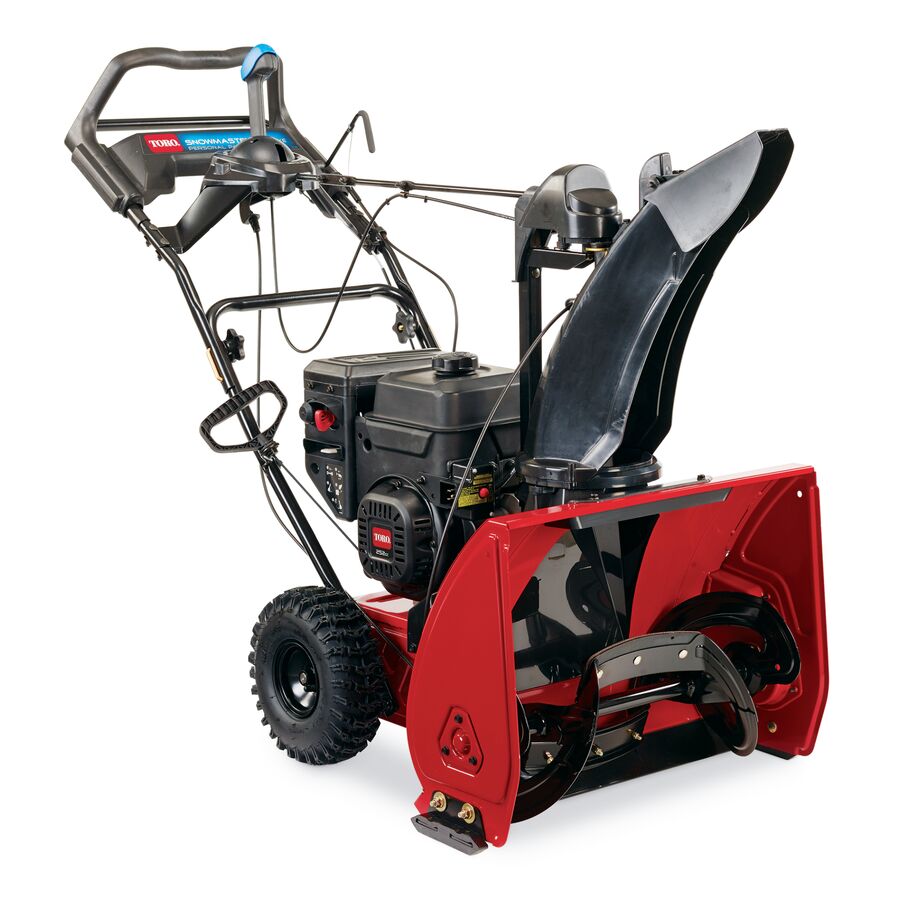
Toro SnowMaster 824 QXE
~$1,24924" wide · 40 ft throw · 131 lb
The 824 QXE is the 724 with a 252cc engine in place of the 212cc and six more pounds on the scale, and that is genuinely the whole difference. Same 24-inch in-line auger, same Personal Pace drive, same 18-inch intake. The larger engine is the answer to the SnowMaster's one real weakness — wet, heavy, late-season snow, where the smaller motor has to be driven slower to keep the auger spinning. For $50 more it is difficult to argue for the 724 unless the machine is going to live somewhere the extra six pounds matters.
Best for The same paved two-car driveway as the 724, in a region where the snow arrives wet and heavy rather than dry and light.
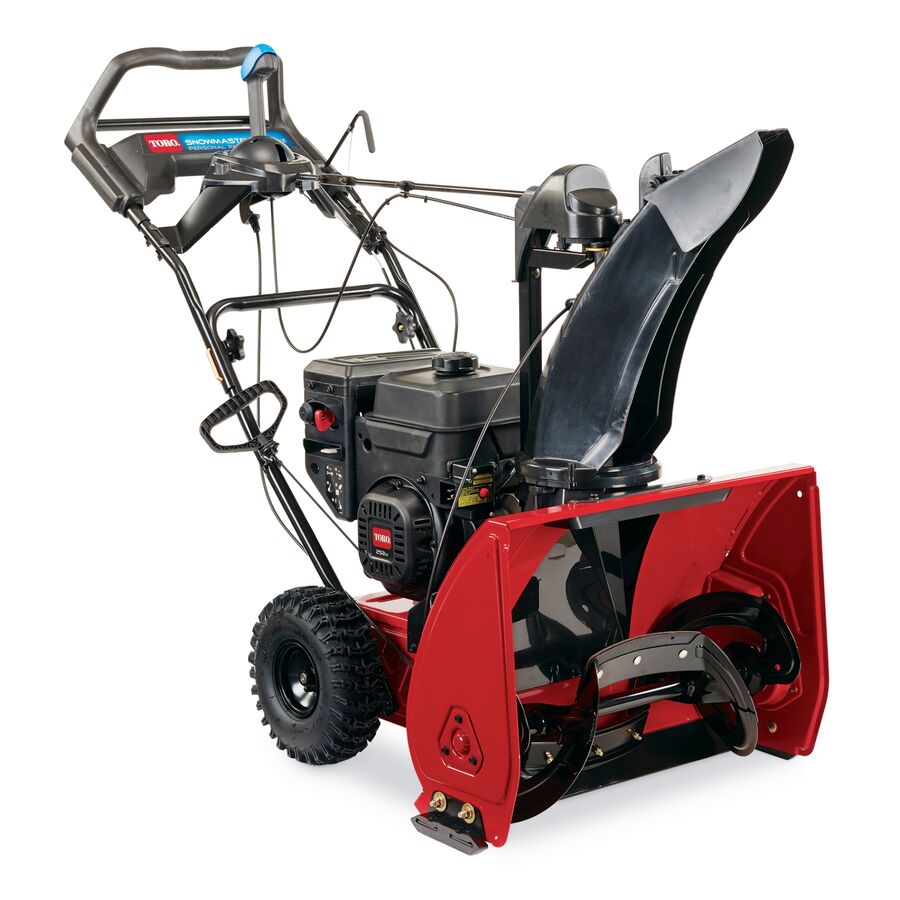
Toro SnowMaster 724 QXE
~$1,19924" wide · 40 ft throw · 125 lb
The SnowMaster is the line Toro built to answer a specific complaint: two-stage machines are slow and heavy, single-stages are too narrow. It takes a 24-inch bite like a two-stage but uses one in-line auger spinning roughly ten times faster than a conventional one, so snow goes straight out the chute instead of being handed to an impeller. The result is a machine that clears a two-car driveway at walking speed and still lifts onto a truck tailgate. The trade-off is honest and worth understanding before you buy: the rubber-edged auger contacts the ground, so this is a paved-surface machine only, and it will not touch a gravel drive. Against the Power Clear 821 QZE it clears three more inches per pass; against the Power Max 824 OE it gives up the ability to handle a packed end-of-driveway berm.
Best for Paved two-car driveways where the storms are frequent but rarely deeper than a foot, and speed matters more than brute force.